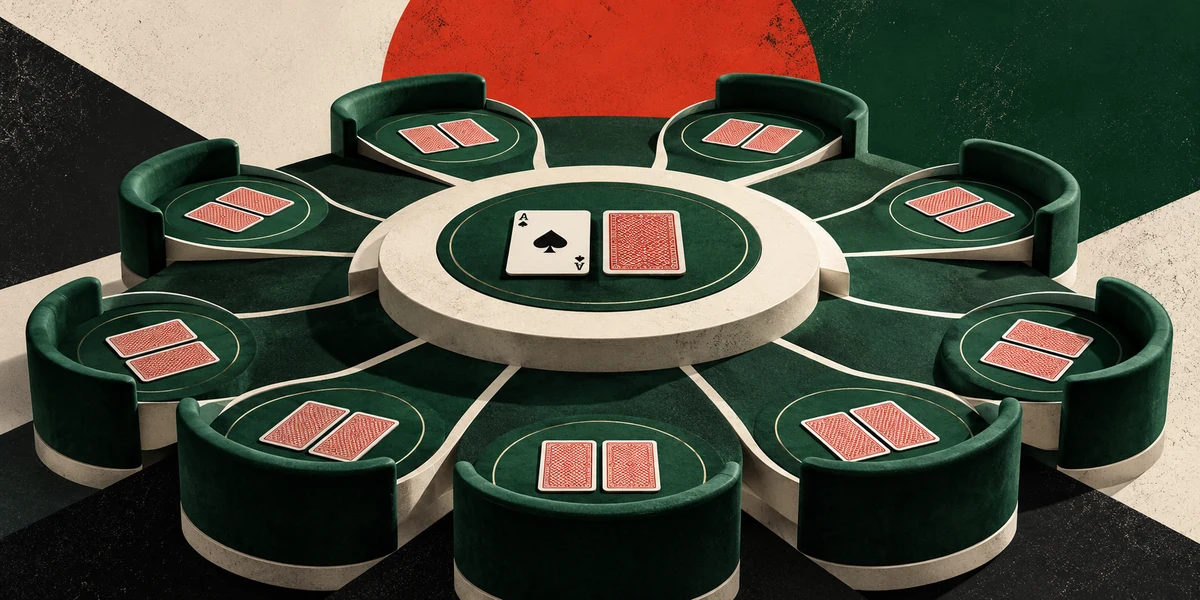
Most live blackjack tables have a ceiling problem: seven seats, seven players, and a long line of people waiting to get in. Scalable one-to-many tables like Evolution's Infinite Blackjack, Pragmatic Play's ONE Blackjack, and Ezugi's Unlimited Blackjack remove that ceiling. One dealer, one shoe, and one set of starting cards serve thousands of players at once, and every player still makes their own decisions.
I'm going to break down how these tables actually work, why someone else's hit can never steal your card, how the 6-Card Charlie rule shifts both the math and your strategy, and why the side bets exist. If you play low stakes during peak hours, this format may be the best game on your screen. You just need to play it correctly.
The Architecture: How One Hand Serves Unlimited Players
A traditional live table is a physical game with a camera pointed at it. Every seat is a real position, every card goes to a specific spot on the felt, and capacity is fixed by the furniture. An infinite-format table works differently. The physical cards are a shared data stream, and the browser client builds a separate hand for each player from that stream, based on the decisions that player makes.
Step 1: The Shared Community Start
When betting closes, the dealer deals two cards face up to a single common player position, plus the dealer's own upcard. Every player at the table, whether there are 40 or 4,000, starts with those same two cards. If the dealer turns over a 10 and a 6 for the community hand against a 9 upcard, every player in the game is looking at hard 16 versus 9.
Optical card recognition reads each card as it comes out of the shoe and sends its value to every connected client. From that point, the game is no longer about seats. It is about decision paths.
Step 2: The Fork Into Individual Decision Trees
During the decision window, your client lets you hit, stand, double down, or split on your own. Nothing you choose depends on anyone else. One player stands on that 16, another hits, and a third holding a different situation (because they split last round's pair, for example) is on a different branch altogether. The software tracks each player's branch separately.
Then the dealer starts drawing cards from the shoe in order. Each new card is offered to every hand that is still taking cards. If you hit your 16 and the next card is a 4, you have 20. Everyone else who hit 16 also gets that 4, because they took the same branch. Players who stood never receive the card. The dealer keeps drawing until every active branch has finished, and then plays out the dealer hand from the cards that follow.
Key Concept
Think of the shoe as one ordered list of cards and your decisions as a filter on that list. Your hand is fully determined by the shared card sequence and your choices. Two players who make identical decisions end up with identical hands. Two players who make different decisions get different hands from the same cards.
Why Other Players' Hits Don't Change Your Hand
This is where newer players get confused, so here is a concrete example. You stand on hard 13 against a dealer 4. Another player hits their 13 and draws a 9, which busts them. Did that 9 "belong" to you? No. You chose not to take a card, so no card enters your hand. Your 13 stays 13 no matter how many cards other players take after you stood.
The sharper version of the question is about the dealer. Because the dealer draws only after every hitting branch is finished, a player who hits five times does push the dealer's draws further down the shoe. So yes, another player's choices can change which specific card the dealer turns over. They cannot change the probability of what the dealer turns over. Every unseen card in an 8-deck shoe is equally likely to be the next one, whether two cards came out before it or ten. This is the same reason the "bad player at third base ruined the table" complaint is a myth at a physical table. Other players move the cards around. They don't move your expected value.
If you want a broader look at how card delivery differs between software-shuffled games and physical shoes, read our RNG vs Live Dealer overview.
The Rule Set and Where the Edge Comes From
Infinite-format tables usually run an 8-deck shoe with fairly player-friendly base rules. The house claws back some value through restrictions on splitting and the absence of surrender. Evolution's Infinite Blackjack is the reference model, and Pragmatic's ONE Blackjack and Ezugi's Unlimited Blackjack follow the same broad structure. That said, rules differ between providers and sometimes between operators, so always open the in-game help panel before your first hand.
| Rule (Infinite Blackjack Reference) | Setting | Approximate Impact on Player |
|---|---|---|
| Number of decks | 8 | Slightly negative vs. fewer decks |
| Dealer soft 17 | Stands | Positive (~0.2% better than H17) |
| Blackjack payout | 3:2 | Standard (6:5 would cost ~1.4%) |
| Double down | Any first two cards | Positive |
| Double after split | Allowed | Positive |
| Resplitting | Not allowed (one split per hand) | Mildly negative |
| Surrender | Not offered | Negative (late surrender worth ~0.08%) |
| 6-Card Charlie | Six non-busting cards win 1:1 | Positive (~0.16%) |
| Net base-game house edge | Optimal strategy | ~0.47% (99.53% RTP) |
Without the Charlie rule, this rule set would sit around 0.63%. The Charlie is what moves Infinite Blackjack from an ordinary 8-deck game into one of the lowest-edge live options you will find at a $1 minimum.
The 6-Card Charlie Rule, Explained
The rule is simple. If your hand reaches six cards without going over 21, it wins immediately and pays 1:1. It doesn't matter what the dealer holds. The Charlie beats a dealer 21, and under the published rules it beats a dealer blackjack too. You get paid before the dealer's hand is even relevant.
The 0.16% gain may look small, but it comes almost entirely from the worst hands in the game. A six-card non-busting hand is nearly always a pile of small cards, typically sitting on a stiff total that would otherwise be in trouble. The rule takes some of your weakest positions and turns them into guaranteed wins. For the full combinatorial breakdown of how often six-card hands occur and what each one is worth, see the 6-Card Charlie EV derivation on BlackjackMath.org. I won't reproduce the matrices here. What matters at the table is what the rule does to your decisions.
Sharp Tip (Marcus Vance):
Count your cards, not just your total. The Charlie only affects your play once you're holding four or five cards. Most players watch the running total and forget the card count entirely. That mistake costs you the most valuable decision this rule creates: the fifth-card hit on a stiff hand.
Strategy Adjustments Under 6-Card Charlie
Standard 8-deck S17 basic strategy covers about 99% of your decisions here. Use it for your first two cards, all splits, and all doubles. The changes appear only on multi-card hands, and they matter most when you're holding five cards.
Why Five-Card Stiffs Change
Basic strategy tells you to stand on hard 14, 15, and 16 against a dealer 2 through 6. That advice assumes your hand will be compared to the dealer's, which means your stiff total wins only when the dealer busts. With five cards in hand, a successful hit doesn't just improve your total. It wins outright. The question is no longer "what's the chance I improve?" but "what's the chance I don't bust?"
Here is the rough math, ignoring small card-removal effects:
- Five-card hard 14: Any Ace through 7 completes the Charlie. That is 7 of 13 ranks, roughly a 54% chance of an instant win. Hitting has a slightly positive expectation. Standing on 14 has a negative expectation against every upcard. Always hit.
- Five-card hard 15: Ace through 6 wins, about 46%. The hit is worth around −0.08 units. Standing on 15, even against a dealer 5 or 6, is worth only about −0.16, because you win only when the dealer busts. Hit against every upcard.
- Five-card hard 16: Ace through 5 wins, about 38%, so the hit is worth roughly −0.23. That beats standing against a weak dealer 2 (and is close against a 3), and it clearly beats standing against 7 through Ace. Against 4, 5, and 6, the dealer's bust rate makes standing slightly better. Hit against 2, 7, 8, 9, 10, and Ace. Stand against 4 through 6. Treat the 3 as a near coin flip.
Keep in mind that a five-card 16 is made almost entirely of small cards, which leaves the remaining shoe a little richer in tens. That is part of why the 16 decisions are marginal. Four-card hands also shift slightly, with a handful of borderline stiffs leaning toward a hit against weak upcards, but those edges are thin. The exact cutoffs, including soft multi-card totals, are tabulated in the Infinite Blackjack strategy adjustments on BlackjackMath.org.
| Five-Card Hard Total | Charlie-Completing Cards | Approx. Win Chance on Hit | Practical Play |
|---|---|---|---|
| 13 or lower | A–8 or better | 62%+ | Always hit |
| 14 | A–7 | ~54% | Always hit |
| 15 | A–6 | ~46% | Hit vs. all upcards |
| 16 | A–5 | ~38% | Hit vs. 2, 7–A; stand vs. 4–6 |
| 17+ | A–4 or fewer | 31% or less | Stand |
If you'd rather drill a printable chart than memorize a table, our Strategy Chart Builder tool lets you enter the exact rule set (8 decks, S17, DAS, no resplit, no surrender, 6-Card Charlie) and generates a chart with multi-card overrides marked.
Warning:
Don't let the Charlie make you reckless on two- and three-card hands. Hitting a two-card 16 against a dealer 6 "because you might get the Charlie" is a real mistake. You would need four more non-busting cards in a row, which almost never happens. The rule rewards discipline at five cards, not wishful thinking at two.
The Side Bets: Who Pays for the $1 Minimum?
A live studio with a professional dealer, multiple cameras, card recognition hardware, and streaming infrastructure doesn't run on $1 base bets at a 0.47% edge. Do the math: a $1 hand at 0.47% gives the house about half a cent in expectation. The format makes economic sense because of volume and, more importantly, because of the side bets offered next to every hand.
| Wager | What It Pays On | Approx. House Edge |
|---|---|---|
| Base game (optimal play) | Beating the dealer | ~0.47% |
| Any Pair | Your first two cards form a pair (suited pairs pay more) | ~4.1% |
| 21+3 | Your two cards plus dealer upcard form a poker hand | ~4–5% (paytable dependent) |
| Hot 3 | Your two cards plus dealer upcard total 19, 20, or 21 | ~5–7% |
| Bust It | Dealer busts; pays more the more cards it takes | Up to ~7.8% |
Side bets run at roughly 9 to 17 times the house edge of the main game. Here is what that means per hour. Assume 50 hands per hour at a $5 base bet with perfect strategy. Your expected loss is about $1.18 per hour. Add a $1 Bust It bet on every hand at 7.8%, and that side bet alone costs about $3.90 per hour. A dollar on the side costs you more than three times as much as the five dollars on the main game.
That is the cross-subsidy. Players chasing a suited-pair payout or a five-card dealer bust fund the studio, and the disciplined base-game player gets a $1 seat at a sub-half-percent edge as a result. If you want the paytable-by-paytable breakdown of the most common one, read our 21+3 side bet audit.
Sharp Tip (Marcus Vance):
In infinite formats, every player sees the same cards, so no side bet becomes playable through a running count the way it sometimes can at a deep-dealt single-player game. Penetration and an 8-deck shoe keep any count-based edge on these side bets theoretical at best. Leave the side bet spots empty and let other players pay for your table.
Why Infinite Blackjack Is the Sharp Low-Stakes Pick on 1win and Stake
On busy evenings and weekends, the standard 7-seat live tables on platforms like 1win and Stake fill up quickly. You're left with three bad choices: wait in a queue, back someone else's hand, or move up to a higher-limit table you didn't plan to play. Backing another player gives up control of your decisions to whoever holds the seat, and our Bet Behind guide explains why that player is often not following basic strategy.
Infinite Blackjack fixes all three problems:
- No seat cap. You're dealt in the moment you place a bet. No queue and no lobby hopping.
- Full decision control. Unlike betting behind, every hit, stand, double, and split is yours.
- $1 minimums at a ~0.47% edge. Very few live games pair a minimum that low with an edge that small.
- Slower, predictable pace. The shared decision timer limits you to fewer hands per hour than a fast single-player RNG game, which keeps your hourly expected loss low.
- No social pressure. No one will blame you for "taking the dealer's bust card," and as we covered, that idea is false anyway.
Some variants advertise a lower effective edge, but compare carefully. Multiplier-based games and doubling-heavy formats can change both the edge and the volatility in ways that don't suit a small bankroll. Our Power and Lightning Blackjack analysis covers where those games fit. For a steady, low-variance grind with a $20 to $100 session bankroll, Infinite Blackjack is the standard to beat.
Warning:
The decision timer is a trap. When it runs out, many clients apply a default action, usually stand, regardless of what basic strategy says. On a slow connection, a timeout on a two-card 11 against a dealer 6 costs you a profitable double. Use a stable connection, decide quickly, and never take time to bet side bets while your main hand is waiting for a decision.
Your In-Session Checklist
- Open the help panel and confirm the rules: S17, 3:2, DAS, 6-Card Charlie. Rules can vary by provider and operator.
- Play standard 8-deck S17 basic strategy for all two-card decisions, doubles, and splits.
- Decline insurance. It is a negative-expectation bet in an 8-deck game without a count.
- On any five-card hand, apply the Charlie overrides: always hit 14 and 15, and hit 16 against 2 and 7 through Ace.
- Leave the side bet spots empty.
- Keep your base bet at 1–2% of your session bankroll so you can handle ordinary variance.
Bottom Line
Infinite Blackjack and its counterparts, Pragmatic's ONE Blackjack and Ezugi's Unlimited Blackjack, take one physical shoe and build a separate hand for every player through software. You share the starting cards, but your hand is shaped only by your own decisions, and no other player's hit can take a card from you or change your odds. The 6-Card Charlie rule adds about 0.16% back to the player and brings the base game to roughly a 0.47% house edge (99.53% RTP). You capture that value by hitting five-card stiffs that standard basic strategy would tell you to stand on. The side bets, priced at about 4.1% to 7.8%, are what pay for the $1 minimum. Skip them, play disciplined strategy with the Charlie overrides, and this becomes the best low-stakes live blackjack option on 1win and Stake when the seven-seat tables are full.