
Most blackjack players who lose money to a casino bonus never lose it at the table. They lose it at the cashier, days after the session ends, when a compliance team reviews their account and finds a single hand that broke a rule buried in paragraph fourteen of the promotional terms. The balance is voided, the bonus is reversed, and the "winnings" are gone. In some cases the deposit goes with them.
This is Mistake #2 in our critical mistake series because it is the most expensive error a disciplined player can make. You can play perfect basic strategy, manage your bankroll correctly, and still walk away with nothing because you treated a bonus like free money instead of a contract. In this guide I will walk you through the specific mechanics casinos use to shut down blackjack bonus play: contribution rates, effective wagering requirements, the max-bet trap, excluded games, and irregular play clauses. Then I will give you a practical protocol for deciding whether to accept a bonus at all.
Why Blackjack Is the Casino's Least Favorite Bonus Game
Understand the casino's perspective first, because every restrictive clause flows from it. A bonus is a marketing cost. The operator gives you $100 in bonus funds and requires you to wager a multiple of that amount before you can withdraw. The wagering requirement exists so the house edge has time to recover the bonus, and then some.
On a slot machine with a 4% to 6% house edge, a 35x wagering requirement grinds most bonuses down to zero. On a well-ruled blackjack game played with correct basic strategy, the house edge can sit around 0.5% or lower. At that edge, the same requirement barely dents the bonus, and the player clears it with a healthy expected profit. Casinos figured this out years ago. Rather than banning blackjack outright, most operators built a legal framework that makes clearing a bonus on blackjack either mathematically unprofitable or procedurally dangerous.
If you want to see exactly how specific rule sets move the edge, run your table's conditions through the house edge calculator on BlackjackMath.org. You need that number before you can evaluate any bonus, and you will need it in the Net EV formula later in this guide.
Contribution Rates: The Fine Print That Multiplies Your Workload
Contribution rate, sometimes called game weighting, is the percentage of each wager that counts toward your wagering requirement. Slots typically contribute 100%. Blackjack almost never does.
What 0%, 5%, and 10% Actually Mean
At 10% contribution, every $10 you bet on blackjack counts as $1 toward your requirement. At 5%, that same $10 counts as $0.50. At 0%, your blackjack play does nothing at all toward clearing the bonus, and in many terms a 0% rating is paired with language stating that play on that game is prohibited while a bonus is active. That distinction matters enormously: a game that "does not contribute" is merely useless, but a game that is "excluded" or "restricted" can void the bonus entirely if you touch it.
Effective Wagering: Why 35x Becomes 350x
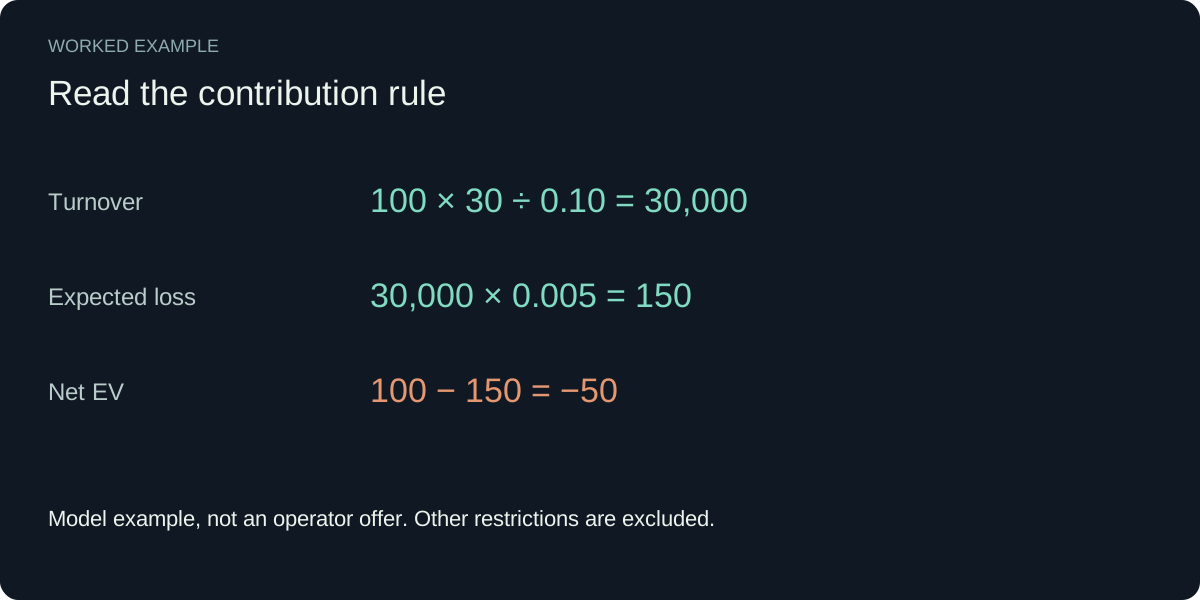
Here is the calculation most players never run. Take a $100 bonus with a 35x wagering requirement. The headline says you need to wager $3,500. But at 10% contribution, you must place $35,000 in blackjack bets to generate $3,500 in counted turnover. Your effective requirement is not 35x. It is 350x the bonus.
Now apply the house edge. At 0.5%, your expected loss on $35,000 of action is $175. The bonus was worth $100. You are mathematically expected to lose $75 for the privilege of clearing it, and that is before accounting for variance, which over $35,000 of action is substantial. Also check whether the requirement applies to the bonus alone or to bonus plus deposit; the latter doubles every number in this section.
| Blackjack Contribution | Effective Multiple | Blackjack Turnover Required | Expected Loss (0.5% Edge) | Net EV on $100 Bonus |
|---|---|---|---|---|
| 100% | 35x | $3,500 | $17.50 | +$82.50 |
| 25% | 140x | $14,000 | $70.00 | +$30.00 |
| 10% | 350x | $35,000 | $175.00 | −$75.00 |
| 5% | 700x | $70,000 | $350.00 | −$250.00 |
| 0% | Infinite | Cannot be cleared | N/A | Bonus is worthless (or a liability) |
Figures assume a 35x requirement on the bonus amount only, perfect basic strategy, and a 0.5% house edge. Weaker rules (6:5 blackjack, dealer hits soft 17, no double after split) push every expected loss higher.
Key Takeaway
Always divide the wagering requirement by the contribution rate to find your true turnover. A 35x requirement at 10% contribution is a 350x requirement in practice. If the expected loss on that turnover exceeds the bonus value, the offer has negative expected value no matter how well you play.
The Max-Bet Trap: How Basic Strategy Gets You Confiscated
Nearly every bonus includes a maximum bet clause while bonus funds are active. A typical version reads: "The maximum stake permitted per round while a bonus is active is $5.00. Wagers exceeding this amount may result in forfeiture of the bonus and all associated winnings." Slot players rarely trip this rule because a spin is a fixed amount. Blackjack players trip it constantly, often without realizing it.
Anatomy of a Violation
You place a $5 initial bet, exactly at the limit. You are dealt 6-5 against a dealer 6. Basic strategy says double. You press the button, add another $5, and your total wager on that round is now $10, double the permitted maximum. Or you are dealt a pair of eights. Basic strategy says always split. You now have $10 on the table across two hands. Draw a 3 on the first eight and double after splitting, and you are at $15.
The software let you do it. The dealer paid you. Nothing flashed on screen. That is precisely the problem: game clients rarely enforce bonus caps in real time. Enforcement happens later, during the withdrawal review, and the clause is written to punish the violation retroactively.
The Automated Audit
When you request a withdrawal on an account that recently held a bonus, most operators run your bet history through an automated filter. It scans for any round where total stake exceeded the cap. One flagged round is enough. You will not be asked whether you meant to break the rule. Whether the casino counts each split hand separately or totals the whole round depends on the wording, and when the wording is ambiguous, the operator interprets it in its own favor.
| Hand Sequence | Multiple of Base Bet | $5 Base vs. $5 Cap | $2.50 Base vs. $5 Cap | $1.25 Base vs. $5 Cap |
|---|---|---|---|---|
| Stand / hit only | 1x | $5 — Safe | $2.50 — Safe | $1.25 — Safe |
| Double down on 11 | 2x | $10 — Violation | $5 — Safe | $2.50 — Safe |
| Split 8s | 2x | $10 — Violation | $5 — Safe | $2.50 — Safe |
| Split, then double one hand | 3x | $15 — Violation | $7.50 — Violation | $3.75 — Safe |
| Split, double both hands | 4x | $20 — Violation | $10 — Violation | $5 — Safe |
Warning:
Insurance and side bets count toward the round total under most "per round" wording. A $5 main bet plus $2.50 insurance is a $7.50 round. Perfect Pairs or 21+3 side bets stack on top of that. If a bonus is active, side bets are almost never worth the compliance risk, and they carry a far higher house edge than the main game anyway.
Sizing Your Base Bet Defensively
The wrong fix is to keep betting $5 and simply refuse to double or split. Abandoning those plays is a deliberate deviation from basic strategy, and stripping doubles and splits out of your game can add more than a full percentage point to the house edge. On $35,000 of turnover, that turns a manageable expected loss into a disaster.
The right fix is to shrink the base bet. Remember that your expected loss is driven by total turnover multiplied by house edge, not by the size of individual bets. Betting $1.25 instead of $5 means more hands to reach the same turnover, but the same expected cost per dollar wagered. You give up time, not money.
Sharp Tip (Marcus Vance):
Set your base bet at 25% of the max-bet cap. That covers split-and-double-both, which handles almost every realistic sequence. On the rare resplit-plus-double that would breach the cap, skip the final double. That deviation occurs so infrequently its cost is negligible, while one flagged round costs you everything. Protect the balance first; optimize second.
Excluded Games: RNG Blackjack vs. Live Dealer
The second structural trap is game eligibility. A common arrangement: RNG (software) blackjack contributes 10%, while Live Dealer blackjack is rated 0% and listed under "restricted games." Players see the word blackjack in the contribution table and assume every blackjack table qualifies. It does not.
Live tables are excluded for two reasons. First, they often carry better rules than RNG versions. Second, they are expensive for the operator to run, and the casino does not want bonus grinders occupying seats. If the terms say restricted rather than merely non-contributing, playing a single live hand with bonus funds active can trigger forfeiture.
Variants are another landmine. Blackjack Switch, Double Exposure, Spanish 21, Free Bet Blackjack, and multi-hand versions are frequently listed separately with their own weightings or exclusions. Some operators exclude any blackjack game where the theoretical return exceeds a stated threshold, such as 99%. That single clause can quietly remove every well-ruled table from eligibility. Read the restricted games list line by line, and match the exact game name in the lobby to the exact name in the terms.
Irregular Play Clauses and the Game-Switching Flag
The most dangerous clause is the vaguest. Nearly every bonus contains language prohibiting "irregular play," "low-risk betting," or "bonus abuse," typically defined at the operator's sole discretion. Blackjack players trigger these clauses through patterns, not individual hands.
The classic pattern is game switching. A player takes a bonus, plays high-volatility slots at large stakes hoping for a big hit, and once the balance balloons, switches to flat-betting blackjack at minimum stakes to grind out the remaining requirement with minimal risk. From the casino's perspective, the player used the bonus to take a free shot at variance, then locked in the gain with a low-edge game. Many terms explicitly name this behavior as irregular.
Other flagged patterns include dramatically dropping bet sizes once a balance target is reached, building up a balance with bonus funds and then reducing stakes to near-zero, and depositing, claiming, and withdrawing on a repeated cycle across multiple promotions. Even when your individual bets are compliant, a pattern that looks engineered can be enough for a compliance officer to invoke discretion.
The defense is consistency. If you play a bonus on blackjack, play it on blackjack from start to finish, at a stable base bet sized to the cap. Do not switch games mid-requirement. And understand the variance you are accepting: grinding $35,000 of action at small stakes produces real swings. Model your bankroll needs with the session variance simulator on BlackjackMath.org before you commit.
A Practical Protocol for Bonus Play
Before You Opt In
- Read the full bonus terms and the general terms. Bonus-specific rules often reference the casino's general T&Cs, where the irregular play clause usually lives.
- Locate the contribution table. Find the exact blackjack variant you intend to play and its exact percentage.
- Find the max-bet wording. Note whether it says "per hand," "per round," or "per bet," and whether doubles and splits are mentioned.
- Check the restricted games list. Confirm live dealer status and any return-to-player thresholds.
- Confirm whether the requirement applies to bonus only or bonus plus deposit.
- Get ambiguous points clarified in writing. Use live chat, save the transcript, and screenshot the terms on the day you opt in. Terms can change.
Calculating Net EV
The formula is simple: Net EV = Bonus Value − (True Turnover × House Edge), where True Turnover equals the wagering requirement divided by the contribution rate. If the result is positive and you can tolerate the variance, the bonus may be worth playing. If it is negative, you are paying the casino for the right to restrict your withdrawals. Our Bonus Clearing Calculator runs these numbers automatically and accounts for deposit-inclusive requirements. For the deeper strategic picture on pacing and turnover tracking, read our Bonus Wagering guide.
When to Decline Outright
Decline the bonus when Net EV is negative, when blackjack contributes 0% or is restricted, when the max-bet cap is so low that a defensive base bet makes clearing impractical, or when the terms are vague enough that you cannot determine compliance with certainty. Declining is not weakness. When you decline, your deposit stays as real cash, withdrawable at any time, with no max-bet cap and full freedom to play any table. For a player whose edge comes from discipline and correct strategy, unrestricted cash is often worth more than a restricted bonus. When you are choosing where to play, compare operators that publish clear, blackjack-friendly terms using our Casinos comparison hub.
Bottom Line
A casino bonus is a contract, and the casino wrote every word of it. Divide the wagering requirement by the contribution rate to find your true turnover, multiply by the house edge, and compare that cost to the bonus value before you opt in. If you play, size your base bet at roughly a quarter of the max-bet cap so doubles and splits never breach it, stay on eligible RNG tables, and keep your betting pattern consistent from first hand to last. If the math is negative or the terms are unclear, decline the bonus and play with clean cash. The most profitable bonus decision is often the one you refuse.