
Every week, a reader emails me some version of the same question: "The casino is offering a 100% match up to $500. I play perfect basic strategy. Shouldn't that be free money?" It's a reasonable question. A low house edge plus a cash bonus sounds like an easy edge. The casino's marketing department does not see it that way, and its legal team has written the terms to make sure it doesn't happen.
This guide covers the actual math of clearing casino promotions with blackjack. You'll learn how to convert any stated wagering requirement into the number that matters, how to calculate the expected value of an offer before you deposit, and how to spot the fine-print clauses that void winnings. By the end, you should be able to judge any bonus in about two minutes and decide whether to claim it or decline it.
Why Online Casinos Fear Blackjack Players
Start with the casino's side of the deal. A bonus is a marketing cost. The operator gives you $500 in bonus funds and expects to recover more than that through the house edge before you can withdraw. The wagering requirement, or "playthrough," is how it does that. It forces you to put a set amount of money at risk so the edge has time to work.
On a slot machine with a 4% to 6% house edge, a 30x requirement on a $500 bonus means $15,000 in wagers. At a 5% edge, that turnover produces an expected loss of about $750. The casino gives away $500 and expects to collect $750. The promotion pays for itself.
Now apply the same terms to a basic strategy blackjack player on a good ruleset, where the house edge is about 0.5%. The same $15,000 of turnover produces an expected loss of only $75. The player keeps an expected $425 of the casino's money. If you multiply that across thousands of disciplined players, the promotion becomes a large loss for the operator.
Casinos understood this decades ago, after organized bonus hunters cleared promotions on blackjack and video poker. Their response was not to ban blackjack. That would drive away recreational players. Instead, they changed how much blackjack wagers count toward the requirement. This is called game weighting, or the contribution rate.
Key Concept
A contribution rate is the percentage of each wager that counts toward your wagering requirement. Slots usually count at 100%. Blackjack commonly counts at 10% to 20%, and sometimes at 0%. At a 10% rate, a $10 blackjack hand clears only $1 of your requirement. The full $10 is still exposed to the house edge.
The Effective Wagering Requirement Formula
The stated wagering requirement in the promotion headline doesn't tell you much on its own. What matters is the effective wagering requirement, which is the real multiple of the bonus you must bet at blackjack. The formula is simple:
Effective WR = Stated WR ÷ Game Contribution Percentage
Then convert it into required turnover in dollars:
Required Turnover = Bonus Amount × Effective WR
And the expected cost of that turnover:
Expected Loss = Required Turnover × House Edge
The expected value of the bonus is the bonus amount minus the expected loss. If the result is positive, the math favors you. If it's negative, you are paying the casino for permission to play.
Case Study: The 30x Bonus at 10% Contribution
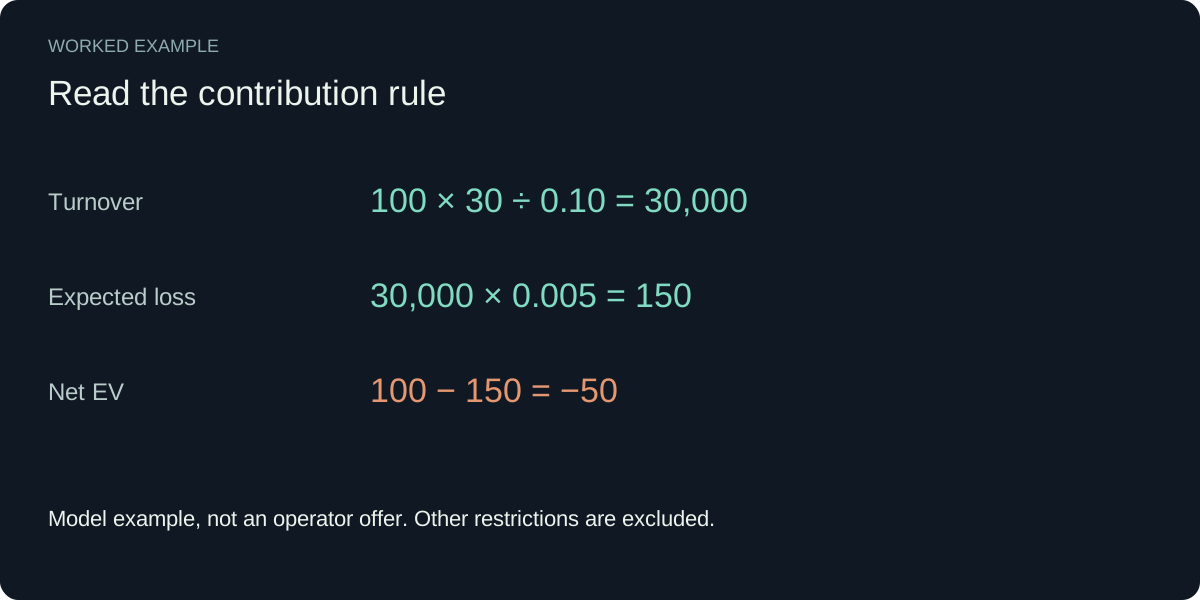
Here's a very common offer: a $500 deposit match with a 30x wagering requirement on the bonus, and blackjack weighted at 10%.
- Effective WR: 30 ÷ 0.10 = 300x
- Required turnover: $500 × 300 = $150,000
- Expected loss at 0.5% edge: $150,000 × 0.005 = $750
- Net expected value: $500 − $750 = −$250
A bonus that looks like $500 of free money is worth about negative $250 to a perfect basic strategy player. The headline says 30x. For a blackjack player, the real requirement is 300x.
Time is a cost too. To stay under a typical $5 max-bet cap, which I'll cover below, you'd be betting around $2.50 per hand. That works out to 60,000 hands. At a fast RNG pace of roughly 400 hands per hour, that's about 150 hours of focused play to end up with an expected loss.
Sharp Tip (Marcus Vance):
Memorize this break-even rule: a blackjack bonus is positive EV only when the effective wagering requirement is below 1 ÷ house edge. At a 0.5% edge, the threshold is 200x. At a 1% edge, it drops to 100x. Divide the stated WR by the contribution rate. If the result is above that threshold, close the tab. You don't need a spreadsheet for this. It's quick mental math.
Comparing Bonus Structures: Where the EV Actually Lives
The table below runs the same $500 bonus through different combinations of stated requirement and contribution rate. It assumes a 0.5% house edge and wagering on the bonus amount only.
| Stated WR | BJ Contribution | Effective WR | Required Turnover | Expected Loss (0.5%) | Net EV |
|---|---|---|---|---|---|
| 30x | 100% | 30x | $15,000 | $75 | +$425 |
| 30x | 50% | 60x | $30,000 | $150 | +$350 |
| 20x | 20% | 100x | $50,000 | $250 | +$250 |
| 30x | 20% | 150x | $75,000 | $375 | +$125 |
| 30x | 10% | 300x | $150,000 | $750 | −$250 |
| 40x | 10% | 400x | $200,000 | $1,000 | −$500 |
| Any | 0% (Live) | Infinite | Never clears | Unbounded | Bonus forfeited |
The pattern is clear. Contribution rate matters more than anything else. A 30x requirement can be worth +$425 or −$250 depending only on how blackjack is weighted. Ignore the bonus size in the banner and look at the game weighting table in the terms.
These numbers depend on the house edge you're actually facing. A 0.5% edge assumes a reasonably good ruleset with 3:2 blackjack and favorable doubling. If the bonus-eligible game pays 6:5 on naturals, hits soft 17, or limits doubling, your edge can rise to 1% or well beyond. That can turn a marginal positive bonus into a losing one. Before you trust any of these numbers, put the exact table rules into the house edge calculator on BlackjackMath.org and use that figure.
The Deposit + Bonus Multiplier Trap
Read the wording closely. Some casinos apply the wagering requirement to the deposit plus the bonus, not just the bonus. A "30x D+B" requirement on a $500 deposit with a $500 match means 30 × 30,000 at 100% contribution. That's twice the turnover of a bonus-only requirement. At a 10% blackjack weighting, it becomes $300,000 in wagers and a $1,500 expected loss, which leaves you about −$1,000 on a "$500 bonus." Always check which amount the multiplier applies to.
The Rare Cases Where Blackjack Bonuses Are Worth Claiming
I'm not telling you to ignore every bonus. Positive-EV blackjack promotions exist. They're uncommon, and you need to know what they look like.
Low Requirements with Meaningful Contribution
The clearest case is a stated requirement of about 20x or less, with blackjack contributing 20% or more. As the table shows, 20x at 20% gives an effective 100x, half the break-even threshold, and about +$250 on a $500 bonus. Offers like this tend to appear in smaller markets, in reload promotions aimed at existing customers, and with operators competing hard for table-game players. If you find one, act quickly. Casinos tend to fix these terms after bonus hunters find them.
Non-Sticky ("Parachute") Bonuses
The second case is structural. A sticky bonus is merged with your deposit and can never be withdrawn. Only winnings above it can be cashed out. A non-sticky or "parachute" bonus keeps your real money and bonus money separate. You play your deposit first. If you win, you can request a withdrawal and forfeit the untouched bonus. Your real-money winnings are yours, with no playthrough. The bonus funds only come into play if your deposit runs out.
This changes the math in your favor. The bonus works as a second chance, a free stop-loss you only use after losing. Even with a heavy effective requirement, the option value can make the overall offer positive, because you only take on the wagering burden in the scenario where you've already lost your deposit. Look for terms that say "real money is wagered first" and allow withdrawals of real-money balances before the bonus activates.
Cashback and Rakeback Alternatives
For many blackjack players, the steadiest value doesn't come from welcome bonuses. It comes from loss-rebate and loyalty programs with little or no playthrough. A 10% cashback on net losses with a 1x requirement is often worth more over time than a flashy deposit match with heavy weighting. I cover how to evaluate these programs in the Rakeback and VIP guide.
The Fine-Print Traps That Void Your Winnings
Even a positive-EV bonus can go to zero if you break one clause. Casinos don't need to beat you at the table if they can confiscate your balance for a terms violation. These are the traps I see most often.
Maximum Bet Rules
Most bonus terms cap your bet while a bonus is active, often at $5 per hand or per round. Blackjack has a feature that catches careful players: doubling and splitting add money to the hand during play. If you bet the full $5 and double on 11 against a 6, you now have $10 on the hand. Many casinos treat that as a max-bet violation. One correct basic-strategy double can be grounds to void every dollar you've won.
Warning:
Never set your base bet at the max-bet ceiling. If the cap is $5, bet $2.50 or less so a double stays legal. If the casino counts total action per round, splits and re-splits can push you over even at half the cap. A pair of 8s split and then doubled can quadruple your stake. In that case, a base bet of $1.25 is the only truly safe choice. Read whether the cap is "per hand," "per round," or "per spin equivalent," and if the wording is unclear, ask support in writing before you play.
Don't respond to the cap by skipping correct doubles and splits. Every basic-strategy deviation raises your house edge, and on a 300x requirement, small increases add up quickly. Reduce your base bet instead. I list the most common versions of this mistake in the Breaking Bonus Terms mistake guide.
Excluded Live Dealer Games
Many terms set different weightings for RNG and live blackjack, and the difference can be severe. A common structure is RNG blackjack at 10%, live dealer blackjack at 0%. Players who prefer the live tables can play for hours without clearing anything. Some casinos go further and list live games as fully restricted while a bonus is active, so playing them can trigger forfeiture. Check the game weighting table for the specific title you plan to play, not just the general "table games" category.
Restricted Multi-Hand and Variant Formats
Multi-hand blackjack, where you play three or five boxes at once, is often excluded or weighted lower. Some operators also count the combined stake across all boxes as one bet under the max-bet rule. Five boxes at $1.50 is $7.50 per round, which breaks a $5 cap. Side bets such as Perfect Pairs and 21+3 are usually weighted at 0%, and some casinos treat any side bet play during a bonus as a breach. Play single-hand, main-bet-only RNG blackjack on a game listed by name as eligible.
Withdrawal Forfeiture, Caps, and Time Limits
Watch for three related clauses. First, withdrawal forfeiture: asking to withdraw before the requirement is complete often cancels the bonus, and with sticky bonuses, it can cancel the winnings tied to it as well. Second, maximum cashout caps: some bonuses limit total withdrawable winnings, often to five or ten times the bonus, which cuts off your upside while leaving your downside intact. Third, expiry windows: a 300x requirement that must be met in seven days means about 21 hours of play per day, which is not realistic. If you can't finish the turnover in the time allowed, the bonus is worth nothing regardless of its theoretical EV.
Also look for vague "irregular play" or "bonus abuse" clauses. These let casinos penalize patterns such as large bet swings or switching between game types. Bet a flat amount, stay on one eligible game, and avoid anything that looks like you're trying to game the system.
Variance: The Hidden Bankroll Problem
Expected value tells you where you end up on average. It doesn't tell you whether you'll get there. Blackjack's standard deviation is about 1.15 units per hand. Over 20,000 hands at $2.50, that's roughly ±$400 of normal fluctuation around your expected result. That's plenty to wipe out a $500 bonus balance before the requirement is cleared. In a sticky bonus, busting your balance ends the attempt, and your deposit is gone too.
That's why bet sizing matters in two directions. Small bets keep you within max-bet rules and reduce your risk of ruin, but they increase the number of hands and the hours required. Larger bets finish faster but raise the chance of busting before you're done. To see how different bet sizes and hand counts affect your chance of completing the turnover, run your numbers through the session variance simulator on BlackjackMath.org. For the full EV calculation, including deposit-plus-bonus structures and time estimates, use our Bonus Clearing Calculator.
The Pre-Opt-In Checklist
Go through this list before you click "claim." If any step fails, decline the bonus. You can always play your own deposit with no restrictions.
- Find the blackjack contribution rate for the exact game you'll play. If it's 0% or not listed, decline.
- Confirm the wagering base: bonus only, or deposit plus bonus.
- Calculate the effective WR: stated WR ÷ contribution.
- Find the actual house edge of the eligible game's rules. Don't assume 0.5%.
- Apply the break-even test: is the effective WR below 1 ÷ house edge? If not, decline, unless it's a genuine non-sticky bonus.
- Calculate net EV: bonus − (turnover × house edge).
- Read the max-bet rule and set your base bet at half the cap or lower, with extra room if splits count per round.
- Check exclusions: live dealer, multi-hand, side bets, specific variants.
- Check the time limit against your realistic hands per hour.
- Check cashout caps and forfeiture clauses.
- Screenshot the terms on the day you opt in, in case they change.
If you're comparing operators on bonus terms, game weightings, and table rules, start with our Casinos comparison hub, where we track the details that the banners leave out.
Bottom Line
Most casino bonuses are built to lose money for blackjack players, and contribution rates are the main reason. Divide the stated requirement by the game weighting to get the true turnover, multiply by the actual house edge, and compare that cost with the bonus. At a 0.5% edge, anything above an effective 200x is negative EV, and a typical 30x offer at 10% weighting costs you about $250 on a $500 bonus. Claim only low-requirement offers with real blackjack contribution, true non-sticky bonuses, or low-playthrough cashback. When you do play, keep your base bet at half the max-bet cap or less, play only eligible single-hand RNG games, and follow the terms exactly. If the numbers don't work, decline the bonus and play your own money on your own terms.