The Sign on the Felt Is the Most Important Rule at the Table
Every blackjack table tells you what it pays for a natural. The phrase is printed in an arc across the felt, usually right above the insurance line: "Blackjack Pays 3 to 2" or "Blackjack Pays 6 to 5." Most players walk past it, buy in, and start playing. That is a costly mistake. Those few words change the house edge more than almost any other rule in the game, including deck count, soft 17, doubling restrictions, and surrender. If you learn only one table-selection skill this year, learn to read that sign and walk away from the wrong one.
This guide covers the full math behind the difference. You will see how often naturals are dealt, how often they actually get paid, what the house gains by cutting the payout, and how many real dollars that costs you over 1,000 hands at $10, $25, and $100 per hand. By the end, you will know why the rule below is non-negotiable.
Key Takeaway: A 6:5 payout takes 0.3 units from every natural you are paid. That adds roughly 1.36% to 1.39% to the house edge, depending on deck count. A respectable 0.45% game becomes a 1.84% grind, which is worse than the pass line at craps. Perfect basic strategy cannot fix it. Never play 6:5 blackjack under any circumstances.
What 3:2 and 6:5 Actually Mean in Dollars
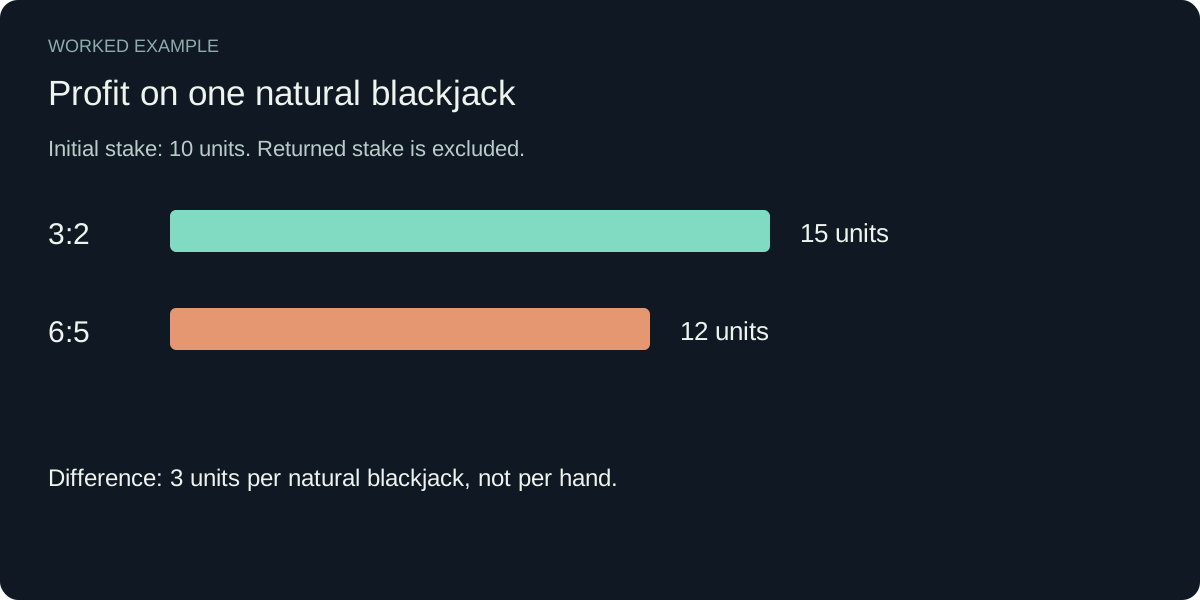
A payout ratio tells you how much you win for each amount you bet. At 3:2, you win 3 units for every 2 units wagered, which is 1.5 times your bet. At 6:5, you win 6 units for every 5 wagered, which is 1.2 times your bet. The numbers 6 and 5 look larger than 3 and 2, and that is part of the trick. Many casual players assume "6 to 5" sounds more generous. It is not. It is 0.3 units smaller on every single natural.
| Bet Size | 3:2 Payout (1.5x) | 6:5 Payout (1.2x) | Lost Per Natural | Lost Per 100 Paid Naturals |
|---|---|---|---|---|
| $5 | $7.50 | $6.00 | $1.50 | $150 |
| $10 | $15.00 | $12.00 | $3.00 | $300 |
| $25 | $37.50 | $30.00 | $7.50 | $750 |
| $50 | $75.00 | $60.00 | $15.00 | $1,500 |
| $100 | $150.00 | $120.00 | $30.00 | $3,000 |
Look at the last column. The loss per natural seems small, only $3 on a $10 bet. But naturals are not rare. You will be dealt one about once every 21 hands. That is two or three times an hour at a full table and more often heads-up. The losses add up fast.
The house's main edge in blackjack comes from one rule: you act first, so if you bust, you lose even when the dealer busts later. The player gets a few things back to offset that. You can double, split, stand on any total, and get paid a bonus for a natural. The 3:2 natural is the largest of these offsets. Cutting it to 6:5 removes a big part of the compensation that makes blackjack one of the best games in the casino.
Deriving the Natural Blackjack Frequency
To measure what the payout cut costs, we first need to know how often you get paid for a natural. That takes two steps. First, find how often you are dealt one. Second, remove the cases where the dealer also has blackjack, because those hands push and nothing is paid.
Step 1: How Often You Are Dealt a Natural
A natural is an Ace plus any ten-value card (10, J, Q, K). In a six-deck shoe there are 312 cards: 24 Aces and 96 ten-value cards. You can get the Ace first and then a ten, or a ten first and then the Ace. So we multiply by two.
P(natural) = 2 × (24/312) × (96/311)
= 2 × 0.076923 × 0.308682
= 0.04749 (≈ 4.75%, about 1 hand in 21)
DEALER ALSO HAS BLACKJACK (pushes your natural)
Remaining: 310 cards, 23 Aces, 95 tens
P(dealer BJ | you have BJ) = 2 × (23/310) × (95/309)
= 0.04562 (≈ 4.56%)
PAID NATURALS (yours, not pushed)
P(paid natural) = 0.04749 × (1 − 0.04562)
= 0.04749 × 0.95438
≈ 0.0452 – 0.0453 (≈ 4.52%)
COST OF 6:5 = payout cut × P(paid natural)
= (1.5 − 1.2) × 0.0453
= 0.3 × 0.0453
≈ 0.0136 (≈ 1.36% of every dollar bet, six decks)
SINGLE DECK: P(natural) = 2 × (4/52) × (16/51) ≈ 4.83%
Paid naturals ≈ 4.65% → cost ≈ 0.3 × 0.0465 ≈ 1.39%
Step 2: Why Pushes Matter
Beginners often multiply 0.3 by the 4.75% dealt frequency and stop there. That overstates the cost a little, because about 1 in 22 of your naturals will run into a dealer blackjack and push. You get your bet back but no bonus, so the payout ratio does not matter on those hands. Taking pushes out leaves about 4.52% to 4.53% of hands where the 3:2 versus 6:5 difference actually changes your result.
Notice the deck-count effect in the math block. With fewer decks, naturals come slightly more often, so cutting the payout hurts slightly more. That is why the commonly quoted penalty is 1.39%, which matches the single-deck games where 6:5 is most common. In a six-deck shoe the figure is closer to 1.36%. Either way, the practical answer is the same: about 1.4% of every dollar you put on the felt goes to the house. For full combinatorial breakdowns by deck count, see the 3:2 vs 6:5 payout derivations on BlackjackMath.org.
From 0.45% to 1.84%: What the Payout Cut Does to the House Edge
A solid 3:2 game with reasonable rules gives the house roughly 0.45% against a perfect basic strategy player. Add the 6:5 penalty of about 1.39% and the edge rises to around 1.84%. That is roughly a fourfold increase in the price you pay to play.
In practice, it is often worse. Casinos that pay 6:5 rarely pair it with good rules. Many 6:5 games also have the dealer hit soft 17, restrict doubling, or ban resplitting Aces. Each of those adds more edge. A 6:5 table showing 2% or higher is common.
| Game / Bet | Approx. House Edge | Expected Loss per $100 Wagered | Verdict |
|---|---|---|---|
| Blackjack 3:2, good rules, basic strategy | 0.45% | $0.45 | Playable |
| Baccarat, Banker bet | 1.06% | $1.06 | Mediocre |
| Craps, Pass Line | 1.41% | $1.41 | Mediocre |
| Blackjack 6:5, same rules, basic strategy | 1.84% | $1.84 | Avoid |
| Blackjack 6:5 + H17 + restricted doubling | 2.0%+ | $2.00+ | Avoid |
| Blackjack paying 1:1 (even money) | 2.7%+ | $2.70+ | Avoid |
| Double-zero roulette | 5.26% | $5.26 | Avoid |
The comparison should change how you view these tables. A 6:5 blackjack game played perfectly is worse than the simplest bet in craps, where you make no decisions at all. You spend hours learning basic strategy, memorizing when to split 8s and double 11, and then you sit down at a table that costs more than a bet any beginner can make with no study.
Why Basic Strategy Cannot Rescue a 6:5 Game
Basic strategy is powerful because of how much it saves compared with guessing. A player who copies the dealer or follows hunches might face a house edge of 2% to 5%. Basic strategy cuts that down to under 1% on a good game. That saving is the whole reward for your study.
The 6:5 payout takes back most of that reward. Your strategy decisions do not change whether you are paid 3:2 or 6:5. Hitting, standing, doubling, and splitting all work the same way. The penalty is applied after you have already played perfectly. There is no play that recovers the missing 0.3 units. You can play every hand correctly and still give up about 1.4% to a single line of text on the felt.
The same problem hits card counters even harder. A typical counter playing a good shoe game might get an overall edge of around 0.5% to 1.5%. The 6:5 penalty wipes that out or turns it negative. The payout also hurts most when counting matters most. High counts mean more Aces and tens, which means more naturals, which means more short-paid naturals exactly when you have your biggest bets out.
Case Study: 1,000 Hands at $10, $25, and $100
Percentages feel abstract, so let us convert them to dollars. Expected loss equals bet size times number of hands times house edge. We compare a 0.45% game (3:2) with a 1.84% game (6:5) over 1,000 hands, which is roughly 10 to 14 hours at a crowded table or about 5 to 6 hours heads-up.
| Flat Bet | Total Wagered | Expected Loss at 3:2 (0.45%) | Expected Loss at 6:5 (1.84%) | Extra Cost of 6:5 |
|---|---|---|---|---|
| $10 | $10,000 | $45 | $184 | $139 |
| $25 | $25,000 | $112.50 | $460 | $347.50 |
| $100 | $100,000 | $450 | $1,840 | $1,390 |
You can check these numbers directly from the natural frequency. Over 1,000 hands, you expect about 45 paid naturals (1,000 × 4.53%). Each one is short by 0.3 units. At $10 per hand, that is 45 × 135, which lines up with the $136 to $139 range from the edge calculation. The two methods agree because they measure the same thing.
Now think about what this means per session. A $25 player getting 70 hands an hour pays about $7.90 per hour at a good 3:2 game. At 6:5, that same player pays about $32.20 per hour. Over a three-day weekend with 12 hours of play, the difference is roughly $290 in expected losses, money you lose for no reason other than choosing the wrong table. That covers a hotel night, a good dinner, or a big part of your next trip's bankroll.
Keep in mind that these are averages. Short-term results swing a lot. You can win on a 6:5 table in a single night, and you can lose on a 3:2 table. But over enough hands, the averages always win out. The 6:5 player is starting every session about four times further behind.
Sharp Tip (Marcus Vance): A $15 bet at a 3:2 table costs you about the same per hand as a $4 bet at a 6:5 table. If the only 3:2 game in the building has a higher minimum, it is often still the cheaper seat. Bet the minimum, play fewer hands, and take more breaks. Do not drop to a 6:5 table just because the sign says $10 instead of $15. Compare expected loss per hour, not the table minimum.
Why Casinos Put 6:5 Tables Where They Do
6:5 tables are not spread randomly. Casinos place them where they are most likely to catch players who will not read the felt or compare options.
- Low-limit tables. Players betting $5 to $15 are more likely to be new, casual, or on a tight budget. These players care about the minimum bet and rarely ask about rules. The casino gets a higher edge from the group least likely to notice.
- Party pits. Tables with loud music, themed dealers, and drink specials focus your attention on the atmosphere. Nobody in a party pit is reading the payout line on the felt. The casino is charging for the entertainment through the payout.
- Single-deck "bait." Many 6:5 games are single-deck, dealt by hand. Players have heard that single-deck blackjack is better, so they sit down happy. In reality, 6:5 single deck is far worse than a 3:2 six-deck shoe. The single-deck appeal hides the payout cut.
- High-traffic areas. Tables near entrances, sportsbooks, and walkways get impulse players. These players often sit at the first open seat without looking around.
- Busy weekends. Some casinos convert tables to 6:5 or raise 3:2 minimums on Friday and Saturday nights, when demand is high and players have fewer options.
The pattern is clear. The casino knows that 3:2 is the better deal for players. It uses 6:5 in exactly the places where it expects you to be distracted. Your job is to stay focused enough to read one line of text before you hand over cash. For a deeper look at how this error plays out, read our breakdown of the sitting at 6:5 tables mistake.
Spotting 6:5 Before You Sit Down
Sometimes the payout is obvious. Other times it is printed in small text or hidden among other felt markings. Use this process every time you approach a table.
- Read the felt arc first. Find the line that says "Blackjack Pays." It will say 3 to 2, 6 to 5, or sometimes 1 to 1 or "Even Money." Do this before looking at the minimum.
- Check the placard. The small sign showing table limits sometimes lists the payout and other rules such as soft 17. Read all of it.
- Watch one natural being paid. If a player has $10 out and gets a blackjack, look at the payout. $15 means 3:2. $12 means 6:5. Chips do not lie.
- Be extra careful with single-deck and double-deck pitch games. These are the most common 6:5 formats. Assume they are 6:5 until you confirm otherwise.
- Ask the dealer if unsure. "Does blackjack pay three to two here?" is a normal question. A dealer will answer it.
- Grade the whole table. Once the payout passes, check soft 17, doubling rules, surrender, and deck count. Our table reading checklist walks through each one, and the Table Grader tool combines them into a single house edge estimate.
Common Excuses and Why They Fail
- "It's only a few dollars per blackjack." It is a few dollars about once every 21 hands, every session, for as long as you play. Over a year, that is hundreds or thousands of dollars.
- "I'm just playing for fun." Fine. Then have fun at a 3:2 table and lose less money. The entertainment is the same. Only the price is different.
- "The other rules are good." No rule combination offsets a 1.39% penalty. Surrender is worth around 0.08%. Doubling after splits is worth about 0.14%. You would need many good rules stacked together just to break even with the payout cut.
- "It's single deck, so it's better." Single deck at 3:2 is excellent. Single deck at 6:5 is one of the worst blackjack games in the building.
- "There are no other tables." Then play something else, take a break, or come back later. Walking away costs nothing.
Most rule changes are worth between 0.05% and 0.25%. The payout change is worth about 1.4%, as much as five to ten ordinary rule changes combined. When you grade a table, check the payout first. If it fails, nothing else on the felt matters. A table with perfect secondary rules and a 6:5 payout is still a table you leave.
Your Pre-Session Payout Checklist
- Confirm the felt says "Blackjack Pays 3 to 2." If it says anything else, leave.
- Watch at least one natural being paid to make sure the felt matches the chips.
- Compare expected cost per hour, not table minimums. A higher-minimum 3:2 table often beats a lower-minimum 6:5 table.
- Treat single-deck and party-pit tables as 6:5 until proven otherwise.
- After the payout passes, grade soft 17, doubling, splitting, and surrender rules.
- If no 3:2 game is available, do not play blackjack that session. Waiting is a winning decision.
The Sharp Rule
Blackjack is one of the few casino games where skill can push the house edge below half a percent. That edge depends on the house paying you fairly when you hit a natural. The 6:5 payout removes 0.3 units from every one, adds roughly 1.36% to 1.39% to the house edge, and turns a good game into one that costs more than the craps pass line. The math does not change with your mood, your budget, or how good the drink specials are.
So the rule is simple and absolute: never play 6:5 blackjack under any circumstances. Read the felt before you sit. Leave if it says 6 to 5. Find the 3:2 game, even if you need to walk across the casino or wait for a seat. That one decision, made before a single card is dealt, does more for your results than any play you will make all night.