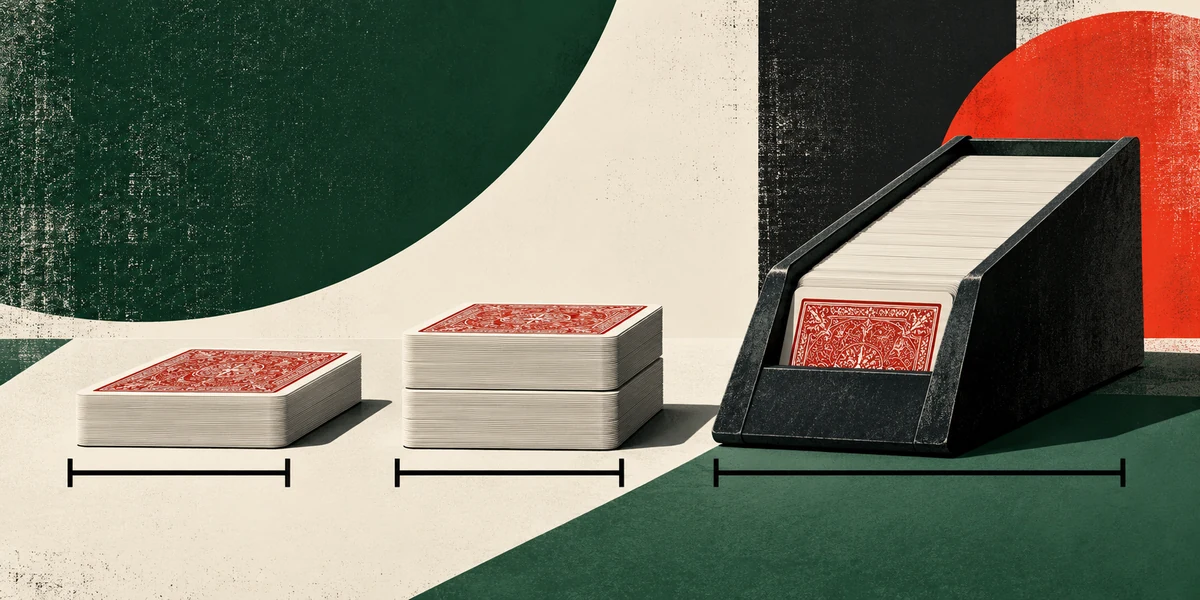
Why Deck Count Matters Before You Ever Place a Bet
Most players treat the number of decks as trivia. It is not. Deck count shapes the probability of every hand, the value of every double, and the speed at which a card counter's edge appears and disappears. Casinos understand this better than most players. They have built rule packages that let them advertise "single deck" while charging you more than a well-ruled eight-deck shoe.
This guide covers the full chain of reasoning. We start with the combinatorics of card removal, quantify the deck-count effect from one deck to eight, and explain why doubling gains the most from fewer decks. Then we look at the counter-measures that cancel that advantage and at penetration and shuffling machines. By the end you should be able to look at a table and say, in tenths of a percent, what it costs you.
Key Takeaway: Fewer decks are worth up to +0.48% to the player, because removing a card from a small deck shifts the remaining composition more sharply. Casinos claw that back with 6:5 payouts (about −1.39%) or doubling restrictions (about −0.26%). The deck count on the sign is meaningless until you price the full rule set.
The Core Mechanism: Card Removal and Conditional Probability
Blackjack is dealt without replacement. Every card that leaves the shoe changes the odds of the cards that remain. In an infinite-deck game this effect vanishes, because each card is always drawn with the same fixed probability. A real game always has finite decks. The fewer decks in play, the larger the change caused by each removed card.
Consider the Ace. A single deck holds 4 Aces among 52 cards. Draw one Ace and you have removed 25% of the remaining Aces. A six-deck shoe holds 24 Aces among 312 cards. Drawing one Ace removes only 1 of 24, or about 4.2%. This asymmetry runs through everything that follows. In small decks, the cards you hold strongly condition the cards you are likely to see next.
The removal effect is the change in the composition of the remaining cards caused by drawing one card. Its size scales roughly with 1/N, where N is the number of cards left. In a 52-card deck, one removal moves the density of any rank about six times as much as it would in a 312-card shoe. Fewer decks therefore means stronger conditioning. That helps the player on blackjacks and doubles, hurts slightly in some dealer-draw situations, and greatly amplifies the information available to a card counter.
Deriving Natural Blackjack Probability by Deck Count
A natural requires one Ace and one ten-value card (10, J, Q, K) in the first two cards, in either order. With D decks there are 4D Aces and 16D ten-value cards among 52D total cards. The derivation is short and it shows exactly where deck count enters.
= 2 × (4D / 52D) × (16D / (52D − 1))
1 deck : 2 × (4/52) × (16/51) = 128 / 2652 = 0.04827 → 4.83%
2 decks: 2 × (8/104) × (32/103) = 512 / 10712 = 0.04780 → 4.78%
4 decks: 2 × (16/208)× (64/207) = 2048 / 43056 = 0.04757 → 4.76%
6 decks: 2 × (24/312)× (96/311) = 4608 / 97032 = 0.04749 → 4.75%
8 decks: 2 × (32/416)× (128/415) = 8192 / 172640 = 0.04745 → 4.75%
Infinite: 2 × (1/13) × (4/13) = 8 / 169 = 0.04734 → 4.73%
Key term: 16D / (52D − 1). The "−1" is the removed Ace.
As D shrinks, that −1 matters more, so the ten density rises.
The first factor, 4D/52D, always equals 1/13. Deck count has no effect on your chance of getting an Ace as the first card. All of the variation sits in the second factor. Once an Ace is out, a single deck has 16 tens among 51 cards (31.37%). An infinite deck still has 30.77%. Removing a non-ten slightly enriches what remains in tens, and that enrichment is largest in the smallest deck.
The gap of about 0.09 percentage points between single deck and infinite deck looks small. Each natural pays 3:2, so the extra frequency converts into a measurable share of the deck-count advantage. Naturals are not the whole story, though. Doubling contributes more.
The Full Deck-Count Effect: +0.48% from Eight Decks to One
Holding all other rules constant, the standard benchmark puts single deck about 0.48% better for the player than eight decks. The relationship is not linear. Most of the gain comes in the last step, from two decks to one, because the removal effect scales with the inverse of the card count.
| Decks | Cards | P(Natural) | Approx. Effect vs 8 Decks | Typical Penetration | Typical Modern Rule Package |
|---|---|---|---|---|---|
| 1 | 52 | 4.83% | +0.48% | 50–65% (1–3 rounds) | 6:5 or H17 / D10-11 / no DAS |
| 2 | 104 | 4.78% | ≈ +0.19% | 55–75% | H17, DAS often allowed, 3:2 in better venues |
| 4 | 208 | 4.76% | ≈ +0.06% | 70–80% | Rare in the US; occasional in European venues |
| 6 | 312 | 4.75% | ≈ +0.02% | 70–85% | Industry standard; S17/DAS/LS on premium tables |
| 8 | 416 | 4.75% | 0.00% (baseline) | 70–80% | Common in Asia and low-limit pits |
| CSM | Varies | ≈ deck count | Slight gain from fewer effective decks, offset by speed | Effectively 0% for counters | Often paired with 6:5 or H17 |
Treat the intermediate values as approximations. Published figures vary by a few hundredths depending on the rule baseline and the simulation method. For exact combinatorial breakdowns, see the deck count and penetration combinatorics on BlackjackMath.org. The important point is the shape of the curve. Six decks and eight decks are nearly identical. Two decks recovers roughly 40% of the single-deck gain. A true single deck sits in a category of its own.
Why Doubling Down Gains the Most From Fewer Decks
A double is a bet that your next card is strong. The usual case is a ten-value card on 10 or 11, or a dealer bust when you double against a weak upcard. Your hard 10 or 11 is almost always built from small cards: 6-5, 7-4, 8-3, 6-4. With the dealer's small upcard, three low cards have left the deck. In a single deck that removal noticeably concentrates the tens that remain.
1 deck : tens remaining = 16 / (52 − 3) = 16/49 = 32.65%
6 decks: tens remaining = 96 / (312 − 3) = 96/309 = 31.07%
Infinite: 4/13 = 30.77%
Relative ten-richness vs infinite:
1 deck : 32.65 / 30.77 = 1.061 → +6.1% more tens
6 decks: 31.07 / 30.77 = 1.010 → +1.0% more tens
Double-stake hands magnify this: every point of extra win probability
is applied to 2 units, not 1.
This is why single-deck basic strategy is more aggressive. In a single deck you double hard 8 against a dealer 5 or 6, double 11 against an Ace even when the dealer stands on soft 17, and double soft hands such as A-8 against a 6 in situations a shoe player would simply stand. Each of these plays has positive expected value only because removing your own small cards tilts the deck in your favour. The extra doubles carry two units of risk each, so they turn the composition shift into money far more efficiently than flat-bet hands do.
Splitting gains in a similar way. When you split 8-8 against a dealer 9 in a single deck, two 8s are gone. The deck is slightly richer in cards that complete the hands well. The effect is smaller than on doubles but it points the same way.
The corollary is the most important insight in this article. Much of the single-deck advantage lives in doubling. A casino that restricts doubling removes the exact mechanism that makes a single deck valuable. That is not an accident.
The Casino Counter-Measures: How the Single-Deck Edge Disappears
Single-deck games are slower to deal, need constant shuffling, and invite counters. Casinos therefore rarely offer one without "compensating" rules. The table below lists the usual levers and their approximate cost to a basic strategy player in a single-deck context.
| Counter-Measure | Approx. Cost to Player | What It Attacks | Net Effect vs +0.48% Deck Gain |
|---|---|---|---|
| Blackjack pays 6:5 | ≈ −1.39% | Natural payout; reverses the frequency gain | Erases it nearly three times over |
| Dealer hits soft 17 (H17) | ≈ −0.19% | Dealer improves soft totals | Removes about 40% |
| Double on 10–11 only | ≈ −0.26% | Hard 8–9 and soft doubles | Removes more than half |
| Double on 9–11 only | ≈ −0.13% | Hard 8 and soft doubles | Removes about a quarter |
| No double after split (NDAS) | ≈ −0.14% | Split-then-double sequences | Removes about 30% |
| No resplitting pairs | ≈ −0.03% | Multiple splits of strong pairs | Minor |
| Continuous shuffler / 1-round shuffle | ≈ 0% basic EV; kills counting | Advantage play entirely | Leaves house edge, removes upside |
Run the arithmetic on a typical Las Vegas Strip single-deck "attraction" table: 6:5, H17, double any two cards, no DAS. It produces a house edge of roughly 1.4–1.6%. Now compare a six-deck shoe with S17, DAS, and late surrender. That game carries a house edge near 0.3%. The single deck costs you roughly five times as much per hand. It is also often dealt faster from a smaller pitch-game rack, so your hourly loss rises further. For the payout comparison in full, read our breakdown of 3:2 vs 6:5 payouts.
Sharp Tip (Marcus Vance): Read the felt before you read the sign. If the layout says "Blackjack pays 6 to 5," walk away. No deck count, no comp rate, and no penetration can rescue a basic strategy player from a 1.39% payout penalty. A 3:2 single deck with H17 and no DAS is still a good game. A 6:5 single deck is a carnival game. If you are unsure, enter the rules into our Table Grader tool before you buy in.
Penetration: The Variable Casinos Control Quietly
Penetration is the share of cards dealt before the shuffle. For a pure basic strategy player it barely matters. Their expected value is essentially independent of where the cut card sits. One small exception is the cut-card effect: a slight negative bias for flat bettors that comes from extra rounds being dealt when the cards are small. It is most visible in single deck. For counters, penetration is close to everything.
The reason is variance in the true count. In a single deck, removing one high card changes the composition far more than in a shoe. Count swings are wide and frequent. The casino knows this and shuffles early. Typical single-deck games are dealt to around 50–65%, which is one or two rounds at a full table. Shoe games can reach 75% or 85%, and the extra depth is where large positive counts come from.
- 50% penetration (single deck): Counts move quickly but you see few hands past the midpoint. This is still workable because single-deck true counts swing hard.
- 75% penetration (six-deck shoe): This is the industry baseline. Counter edges are thin, typically a few tenths of a percent with a moderate bet spread.
- 85% penetration (six-deck shoe): This is premium. The frequency of counts of +3 or higher rises sharply and expected win per hour can nearly double compared with 75%.
The non-linearity is the key. The last 10% of a shoe produces a disproportionate share of extreme counts. A cut card moved from one deck off to a deck and a half off can be worth more to a counter than a full rule improvement. The deck count and penetration combinatorics on BlackjackMath.org show exactly how true-count distributions widen as penetration deepens.
Continuous Shuffling Machines vs Manual Shoes
A continuous shuffling machine (CSM) recycles discards back into the pool after every round or two. The game behaves almost like an infinite stream. There is no meaningful depletion, no true count to track, and no penetration in the sense a counter uses. Basic strategy EV is roughly comparable to an equivalent hand-shuffled game. If anything it is marginally better, because the effective deck count is fewer than the cards loaded.
The real cost is speed. CSMs remove shuffle downtime, so you play perhaps 15–20% more hands per hour. If the house edge is 0.5% and you bet $25 a hand, going from 70 to 84 hands an hour raises expected hourly loss from about $8.75 to $10.50. Faster negative-EV play is not a feature. Automatic shufflers that shuffle one shoe while another is dealt are a different machine. They still give you real penetration, and you should not confuse them with CSMs.
Single Deck vs Double Deck vs Shoe: The Practical Verdict
- A 3:2 single deck with reasonable rules is among the best games available to a basic strategy player. House edge can fall below 0.2%. Learn the single-deck strategy deviations from shoe strategy; there are more doubles.
- A 3:2 double deck with DAS is often the best real-world compromise. It keeps a meaningful share of the deck-count gain and offers counters solid penetration. Casinos also guard it less aggressively.
- A six-deck shoe with S17, DAS, and late surrender is the reliable workhorse. It frequently beats "single deck" signs on rules alone, and with 80%+ penetration it is an excellent counting venue.
- Eight-deck H17 games and any 6:5 game are low-value tables. Play them only for entertainment with a fixed loss budget.
Table Selection Checklist
- Confirm the blackjack payout on the felt: 3:2 or nothing.
- Count the decks. Look at the discard tray, the shoe, or the dealer's hand in pitch games.
- Check soft 17: S17 is worth about 0.2% over H17.
- Check doubling: any two cards beats 9–11, which beats 10–11. This matters most in single and double deck.
- Check DAS and surrender availability.
- Estimate penetration by watching where the cut card goes. A rough eyeball estimate is enough.
- Identify CSMs. If discards go back into the machine every round, counting is dead.
- Price the whole package rather than any single rule. Use our guide on how to read a table and verify with the Table Grader tool.
Final Word From the Research Desk
Deck count is a real, quantifiable edge component. The math is clean: smaller decks magnify removal effects, which raises natural frequency and makes doubles and splits more profitable. That math is also exactly why casinos neutralize it. They cut the natural payout, restrict doubling, shuffle early, or install machines that make depletion irrelevant. A sharp player does not chase the word "single" on a placard. You add up the rule package, convert each rule into its basis-point cost, compare the total against the alternatives in the pit, and sit at the table with the lowest number. Decks are one input. The full sum is the decision.