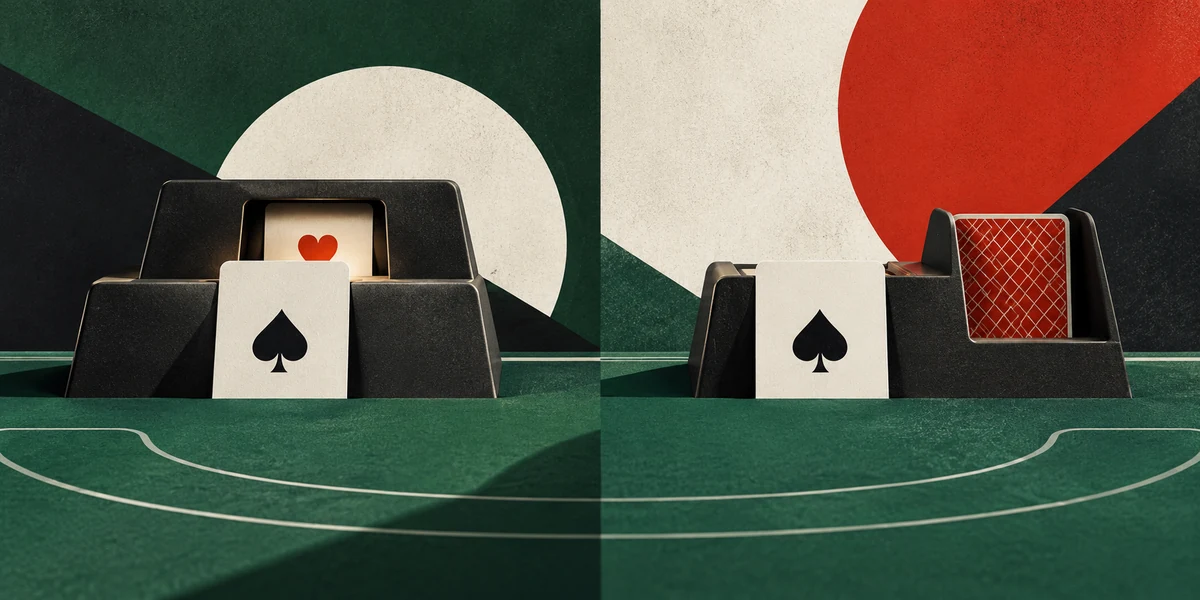
Peek vs No Hole Card: The Rule Hidden in the Deal
Most players compare blackjack tables on the obvious rules: 3:2 versus 6:5, S17 versus H17, deck count, double-after-split, surrender. Many skip the procedural rule that decides when the dealer receives the second card. That rule determines whether your doubles and splits against a dealer 10 or Ace are protected. Under the European No Hole Card (ENHC) procedure they are not, and that exposure costs a basic strategy player roughly 0.11% of every dollar wagered. That is about the same as losing double-after-split.
This guide explains the mechanics, derives where the cost comes from, gives the four strategy changes you must make at an ENHC table, and shows how to identify ENHC on live dealer streams and RNG software before you risk money. If you already know the basics of how to read a table, treat this as the advanced layer: a rule that is rarely printed on the felt but shows up in your results.
Key Takeaway: In a peek game, a dealer blackjack can only take your original bet. In a full-loss ENHC game, it takes your doubles and splits too. That adds about 0.11% to the house edge. You can reduce the damage by never doubling 11 or 10 against a 10 or Ace, hitting 8,8 against a 10 or Ace, and hitting A,A against an Ace. If you have a choice, play at a peek or Original-Bets-Only table.
How the American Hole Card (Dealer Peek) Works
In the standard American procedure, the dealer takes two cards: one face up and one face down (the hole card). When the upcard is a 10-value card or an Ace, the dealer checks the hole card before any player acts. This is done with a peeking device or optical reader, or by a manual check in older pits. With an Ace showing, insurance is offered first, and then the dealer checks.
If the dealer has a natural, the hand ends immediately. Every player without a blackjack loses only the original wager, and player blackjacks push. Nobody has had a chance to double or split, so no extra money is at risk.
If the dealer does not have a natural, play continues. Every decision you make is now conditional on the dealer not having blackjack. This is the key point. When you double 11 against a dealer 10 in a peek game, you already know the hole card is not an Ace. Your extra money only faces the dealer's non-blackjack outcomes.
What the Peek Gives You
The peek is information, and in blackjack information is worth money. The dealer looks at a card you cannot see, but the result of that look ("no blackjack") is shared with you through the fact that the hand continues. Every peek-game basic strategy chart is built on that conditional information.
How European No Hole Card (ENHC) Works
Under ENHC, the dealer takes one card only, face up. There is no hole card and no peek. Every player completes their hand first: hitting, standing, doubling, and splitting. Only then does the dealer draw a second card. If that card makes a natural (an Ace under a 10, or a 10 under an Ace), the dealer has blackjack.
In the classic full-loss version, a dealer blackjack wins every chip you have on the table. If you doubled 11 against a 10 and the dealer turns over an Ace, you lose two units instead of one. If you split 8,8 against an Ace, resplit to three hands, and the dealer draws a 10, you lose three units on a hand where a peek game would have cost you one.
Some no-hole-card tables add an Original Bets Only rule, also called OBO or "dealer blackjack takes original bets only." Under OBO, if the dealer draws a natural after you have doubled or split, the extra money is returned and you lose only the original wager. For basic strategy, an ENHC game with OBO is mathematically equivalent to a peek game: the 0.11% penalty disappears and you use the standard peek chart. The procedure does not cost you money. Losing the extra bets does. Always check which version you are sitting at.
Side-by-Side Rule Comparison
| Feature | American Peek | ENHC (Full Loss) | ENHC + OBO |
|---|---|---|---|
| Dealer's second card | Dealt immediately, face down | Dealt after all players act | Dealt after all players act |
| Blackjack check vs 10/A | Yes, before player decisions | No | No |
| Loss to dealer natural | Original bet only | All bets, including doubles and splits | Original bet only (extras refunded) |
| House edge vs peek baseline | 0.00% | About +0.11% | About 0.00% |
| Correct strategy chart | Standard peek chart | ENHC-specific chart | Standard peek chart |
| Typical venues | US casinos, many US-facing RNG games | UK and European land casinos, many European-studio live tables | Selected land and online variants |
Where the 0.11% Comes From: The Derivation
The cost is easy to compute once you see the structure. If the dealer does not end up with a natural, the two procedures produce identical outcomes. Your hand plays out against the same distribution of dealer totals. Every bit of difference sits in the rounds where the dealer has blackjack, and in those rounds ENHC takes your extra stakes.
Let q be the probability that the dealer completes a natural given the upcard. Using an infinite-deck approximation, q = 1/13 ≈ 7.69% under a 10 (the hole card must be an Ace) and q = 4/13 ≈ 30.77% under an Ace (the hole card must be one of four 10-value ranks). Let Ex be the peek-game EV of action x, which by construction is conditional on no dealer blackjack. Let sx be the total units staked by that action.
-----------------------------------------------
EV_ENHC(x) = -q · s_x + (1 - q) · E_x
Double (s=2) vs Hit (s=1):
Double preferred iff (1-q)(E_dbl - E_hit) > q
=> E_dbl - E_hit > q / (1 - q)
Split (s=2) vs Hit (s=1): same threshold
=> E_split - E_hit > q / (1 - q)
Upcard 10: q = 1/13 -> threshold = 1/12 ≈ 0.0833 units
Upcard A : q = 4/13 -> threshold = 4/9 ≈ 0.4444 units
Gross exposure if you keep PEEK strategy (two-card hands, infinite deck):
vs 10: P(11)=8/169, P(8,8)=1/169, P(A,A)=1/169
10/169 × P(up 10)=4/13 × q=1/13 = 40/28561 ≈ 0.140%
vs A : P(8,8)+P(A,A) = 2/169
2/169 × P(up A)=1/13 × q=4/13 = 8/28561 ≈ 0.028%
Gross ≈ 0.168% (before resplits/DAS, before strategy correction)
Full combinatorial analysis with corrected ENHC strategy ≈ 0.11%
Two conclusions follow. First, the gross exposure of playing a peek chart at an ENHC table is about 0.17% under this simplified model. Resplits and double-after-split add more exposure on top of that. Second, switching to the ENHC chart recovers part of the loss by declining doubles and splits whose edge does not clear the new threshold. After accounting for a finite shoe, removal effects, and the corrected strategy, the net figure is roughly 0.11%. For exact figures by deck count and rule set, see the ENHC vs Peek EV calculations on BlackjackMath.org. Their combinatorial tables are the reference values, and I will not reproduce them here.
Putting 0.11% in Perspective
A 0.11% penalty is roughly the value of double-after-split, and about half the cost of moving from S17 to H17 in a six-deck shoe. At $25 a hand and 80 hands an hour, that is $2,000 of hourly action, so ENHC costs you about $2.20 per hour in expectation. Over a 200-hour year that is about $440. For a card counter working a 1% edge, losing 0.11% removes about one-ninth of the edge, and you get nothing in return for it.
The Four Essential ENHC Strategy Shifts
The thresholds in the math block determine every change. Against an upcard of 2 through 9 the dealer cannot have blackjack, so q = 0 and your peek strategy is unchanged. Changes only happen against a 10 or an Ace.
1. Never Double 11 vs 10 or Ace
In a typical multi-deck S17 game, doubling 11 against a 10 beats hitting by only about 0.05 to 0.06 units on a conditional basis. That is below the 0.0833 threshold, so the double loses money under ENHC and you hit. Against an Ace the threshold is 0.444 units, which no doubling gap comes close to, so you hit 11 against an Ace even in H17 games where peek strategy says double.
2. Never Double 10 vs 10 or Ace
Peek basic strategy already hits 10 against a 10 or Ace, but plenty of players double these hands on instinct. Under ENHC the case against doubling is even stronger: the threshold goes up while the edge from doubling stays the same. Hit, every time.
3. Never Split 8,8 vs 10 or Ace: Hit Instead
This one surprises players who learned "always split aces and eights." In a peek game, splitting 8s against a 10 beats hitting 16 only because both options are bad and splitting is slightly less bad. The gap is roughly 0.06 to 0.07 units. Under ENHC, putting a second unit out with a 1-in-13 chance of losing it immediately erases that gap, so you hit the 16. Against an Ace, with q above 30%, the split is clearly wrong. If late surrender is offered and the rules let you surrender before the dealer resolves, compare it with hitting using the Strategy Chart Builder. ENHC surrender rules vary widely.
4. Never Split A,A vs Dealer Ace
Splitting Aces against an Ace is strong in a peek game, worth roughly 0.3 units more than hitting soft 12. That still falls short of the 0.444 threshold. Hit the pair as a soft 12. Against a 10, however, the split-Aces edge is large enough to clear the 0.0833 threshold, so keep splitting A,A against a 10.
Sharp Tip (Marcus Vance): Memorize one rule: "Against a 10 or Ace at an ENHC table, I only add money when the edge is huge." In practice that leaves one split: A,A against a 10. Everything else against those upcards is played with the original bet only. Hitting 8,8 against a 10 will feel wrong. Do it anyway, because the arithmetic does not change based on how the hand feels.
ENHC Strategy Shift Reference
| Hand vs Upcard | Peek Play | ENHC Play (Full Loss) | Why |
|---|---|---|---|
| 11 vs 10 | Double | Hit | Gap ~0.05–0.06 < 0.0833 threshold |
| 11 vs A | Hit (S17) / Double (H17) | Hit | Threshold 0.444, unreachable |
| 10 vs 10 or A | Hit | Hit | No longer even close |
| 8,8 vs 10 | Split | Hit (or surrender if properly offered) | Gap ~0.06–0.07 < 0.0833 |
| 8,8 vs A | Split | Hit | q ≈ 30.8% overwhelms the split edge |
| A,A vs A | Split | Hit | Gap ~0.3 < 0.444 |
| A,A vs 10 | Split | Split | Gap comfortably > 0.0833 |
| Any hand vs 2–9 | Peek chart | Peek chart (unchanged) | Dealer cannot make a natural |
Insurance, Even Money, and Surrender Under ENHC
Insurance is often still offered at ENHC tables, with the side bet resolved after the dealer's second card. The math is identical to a peek game: the bet pays 2:1 on a 4/13 chance in an infinite deck, which is a losing bet for anyone not tracking 10 density. Even money is the same insurance bet under another name. For full context on the Ace upcard, read our guide on playing against dealer ace.
Surrender needs careful reading at ENHC tables. Some games offer a surrender that only applies if the dealer does not complete a natural, which makes it effectively late surrender. Others allow surrender that is honored even if a natural appears, which is much more valuable against a 10 or Ace. The rule card's wording decides which you have, so read it before you play.
Card Counting Implications
For counters, ENHC changes the index structure against 10 and Ace. A 10-rich shoe raises q under an Ace, which increases the penalty on any additional money you put out against that upcard. Under a 10, a rich shoe slightly lowers q, because more 10s means proportionally fewer Aces, and it also improves doubling outcomes. As a result, the 11 vs 10 double comes back at a modest positive true count instead of being a default play. Do not use peek-game indices at ENHC tables. Generate ENHC-specific index numbers with the Strategy Chart Builder and drill them separately. Also note that because you lose more in dealer-blackjack rounds, your variance against 10 and Ace upcards is concentrated in a few large losses.
How to Recognize ENHC in Online Casino Streams and Live Dealer Software
Operators rarely highlight ENHC in their marketing. Here is how to identify it.
Visual Cues on Live Streams
- One dealer card during player decisions. If the dealer's spot shows a single face-up card while players act, and no face-down card sits beside it, the table is no-hole-card.
- No peek sequence. Peek tables show a short pause, a reader check, or an on-screen "Checking for blackjack" message when a 10 or Ace is showing. ENHC tables skip this and go straight to decisions.
- The second card is dealt after the last decision. Watch a hand where the dealer shows a 10. If the dealer's second card only appears after the betting timer ends, you are looking at ENHC.
Text Cues in Help Files and Rule Cards
- Phrases such as "The dealer receives a second card after all players have completed their hands," "Dealer does not check for blackjack," or "Dealer peeks: No."
- Full-loss wording: "If the dealer has blackjack, all player bets lose, including doubles and splits" or "Player loses all wagers to dealer blackjack."
- OBO wording: "Original bets only," "Doubled and split bets are returned if dealer has blackjack," or "Dealer blackjack takes original stake only."
- Partial-protection variants exist where some extra bets are refunded and others are not. Read the exact wording rather than assuming.
RNG Testing Protocol
For RNG tables, use free-play mode to test. Play until the dealer shows a 10 or Ace and you hold a doubling or splitting hand, then double or split. If the dealer then makes a natural and the game takes the full amount, the table is full-loss ENHC. If the game ends the hand before you can act whenever the dealer has a natural, the game uses a peek.
Practical ENHC Table-Selection Checklist
- Confirm the blackjack payout first. A 6:5 table is far worse than any hole-card issue, so leave it regardless.
- Watch one dealer 10-up hand. Count the dealer's cards before players act: two cards means peek or hole card, one card means ENHC.
- Open the help file and look for "original bets only" or full-loss wording.
- If ENHC with full loss, add 0.11% to your house edge estimate and compare against the alternatives available.
- If ENHC with OBO, use the peek chart without adjustment.
- If you play full-loss ENHC, load the ENHC chart: hit 11 and 10 against 10/A, hit 8,8 against 10/A, hit A,A against an Ace, and still split A,A against a 10.
- Check the surrender wording. Know whether surrender holds up against a dealer natural.
- If you count, switch to your ENHC index set and stop using peek indices against 10 and Ace.
- Decline insurance and even money unless your count justifies it.
The Verdict for Table Selection
ENHC is not a scam. The rule is disclosed, the math is public, and the penalty is modest. It is still a real, measurable cost that most players pay without noticing, often while making it worse by keeping peek-chart habits. If a peek table and a full-loss ENHC table have otherwise identical rules, the peek table is better by about 0.11%. If the ENHC table has OBO, the two are equivalent.
When ENHC is your only option, the four adjustments above recover a meaningful share of the cost. The key mental change is that against a 10 or Ace, the dealer's possible natural is part of every decision you make, and you only add money when your edge clearly exceeds that risk.