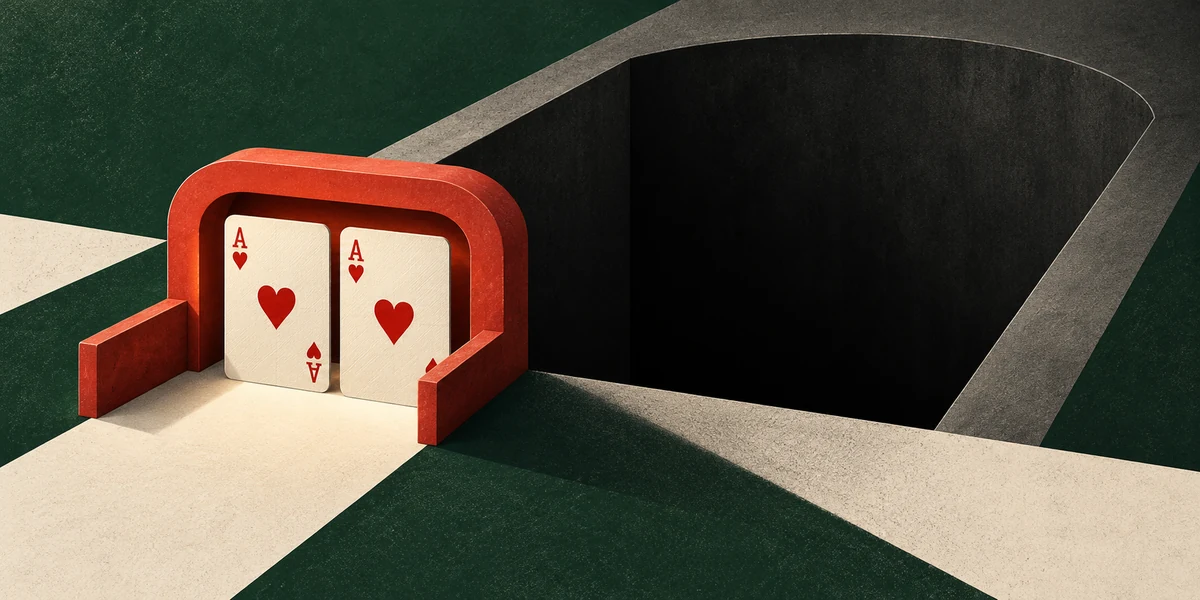
Walk up to almost any blackjack table in Las Vegas, Atlantic City, London, or Macau and you'll likely see a small circle next to the main betting spot labeled Perfect Pairs. It's one of the oldest and most widespread side bets in the game, and it sells itself easily. Payouts of 25:1 or 30:1 look generous, and anyone who has played for an hour has seen a pair dealt. It feels like it should hit often enough to be worth a chip.
It isn't. I'm going to take this bet apart so you understand exactly why, using the same practical lens I'd use with a student sitting next to me at the table. We'll cover how the bet works, what each tier really pays you on average, why deck count changes everything, and why the paytable that looks best is sometimes the worse deal. You'll also find out what a few "harmless" $5 chips really cost you per hour.
How the Perfect Pairs Bet Works
Perfect Pairs is a proposition wager on your first two cards only. You place it alongside your main bet before the deal. Once your two cards are face up, the side bet is settled on one question: are they the same rank? A 7 and a 7 qualify. A King and a Queen do not, even though both count as ten in the main game. The dealer's cards, your later draws, and the outcome of your hand have no effect. The side bet is decided before you make a single playing decision.
That independence matters. Because it settles on the first two cards, Perfect Pairs is a pure game of chance. No skill, strategy, or table decision can change its outcome. Your only control is the decision to place the chip, so that is the decision worth getting right.
The Three Winning Tiers
Every Perfect Pairs paytable ranks pairs by how closely the two cards match beyond rank:
- Mixed Pair: Same rank, different color and different suit. Example: 7♠ + 7♦. Standard pay is 6:1. Weaker paytables pay 5:1.
- Coloured Pair: Same rank, same color, different suit. Example: 7♥ + 7♦. Standard pay is 12:1. Some tables pay 10:1.
- Perfect Pair: Same rank and same suit. Example: 7♠ + 7♠. Standard pay is 25:1. Some tables pay 30:1.
Notice the third tier. Two identical cards of the same suit can only exist when the game uses more than one deck. That simple fact is the key to understanding the entire bet.
Key Concept
Perfect Pairs depends on one number: how many cards in the remaining shoe match your first card in rank, color, and suit. Every probability in this bet comes from counting those matching cards against the cards left. Change the deck count and you change every one of those odds, which changes the house edge.
Why Deck Count Is Everything
Start with the extreme case. In a single-deck game, there is exactly one 7♠. Once it's your first card, no second 7♠ exists, so the probability of a Perfect Pair is exactly zero. The top tier on the paytable can never pay. That's one reason casinos rarely offer this bet on single-deck games. When you do see it there, the math is brutal.
Now look at an 8-deck shoe of 416 cards. Each rank appears 32 times and each specific card, such as the 7♠, appears 8 times. After your first card, 415 cards remain. Of those:
- 7 cards complete a Perfect Pair (the other copies of your exact card).
- 8 cards complete a Coloured Pair (the same rank in the other suit of your color).
- 16 cards complete a Mixed Pair (the same rank in the two suits of the opposite color).
- 384 cards lose.
That gives a Perfect Pair probability of about 1.69% (roughly 1 in 59 hands), a Coloured Pair at 1.93%, and a Mixed Pair at 3.86%. Total pair probability is 7.47%, about 1 pair every 13.4 hands. You lose the wager on 92.53% of all rounds dealt.
You'll sometimes see the 8-deck Perfect Pair frequency quoted as "0.59%" or "1 in 170." That's a misreading. Seven matching cards out of 415 is 1.69%. The correct figure still produces a losing bet, so you don't need an exaggerated number to make the case. The real tier-by-tier counts are laid out in the Perfect Pairs RTP and combinatorial proof on BlackjackMath.org, and I'd encourage every serious player to work through them once.
| Outcome | 8-Deck Probability | 8-Deck Frequency | 6-Deck Probability | 6-Deck Frequency |
|---|---|---|---|---|
| Perfect Pair | 1.69% (7/415) | ~1 in 59 | 1.61% (5/311) | ~1 in 62 |
| Coloured Pair | 1.93% (8/415) | ~1 in 52 | 1.93% (6/311) | ~1 in 52 |
| Mixed Pair | 3.86% (16/415) | ~1 in 26 | 3.86% (12/311) | ~1 in 26 |
| Any Pair | 7.47% | ~1 in 13.4 | 7.40% | ~1 in 13.5 |
| No Pair (Loss) | 92.53% | — | 92.60% | — |
Look at the pattern. Coloured and Mixed pair odds hardly change between six and eight decks. The top tier does almost all the moving. Each deck you remove takes away one potential Perfect Pair match while the total card count also falls, and the 25:1 tier is the one that carries the bet's value. That's why fewer decks means a worse side bet, the reverse of the main game, where fewer decks generally helps you. For more on how deck count shapes every game you sit down at, see my deck count guide.
House Edge Across Real Casino Paytables
The house edge comes from weighing each payout by its probability and subtracting the losses. You can follow the logic without a matrix. On the standard 25/12/6 paytable in an 8-deck shoe, the winning outcomes return 367 units for every 415 hands where you risked 1 unit each. The 384 losing outcomes cost 384 units. The net is a loss of 17 units per 415 hands, a 4.10% house edge. That is the best case you'll normally find, and it's still roughly eight times the edge on a well-played main game.
Here's how the common paytables compare:
| Decks | Paytable (Perfect / Coloured / Mixed) | House Edge | Cost per $100 Wagered |
|---|---|---|---|
| 8 | 30 / 10 / 5 | 3.37% | $3.37 |
| 8 | 25 / 12 / 6 | 4.10% | $4.10 |
| 6 | 30 / 10 / 5 | 5.79% | $5.79 |
| 6 | 25 / 12 / 6 | 6.11% | $6.11 |
| 4 | 25 / 12 / 6 | 10.14% | $10.14 |
| 8 | 25 / 10 / 5 | 11.81% | $11.81 |
| 6 | 25 / 10 / 5 | 13.83% | $13.83 |
| 2 | 25 / 12 / 6 | 22.33% | $22.33 |
The Paytable Illusion
This is where the title of this guide comes from. Most players compare paytables by looking at the bottom two tiers, because those are the pairs they see most often. A 12:1 Coloured Pair and a 6:1 Mixed Pair feel richer than 10:1 and 5:1. Run the numbers, though, and in both 6-deck and 8-deck games the 30/10/5 table carries a lower house edge than 25/12/6. The extra five units on the Perfect Pair outweigh the cuts to the lower tiers.
The paytable that's genuinely predatory is the one that mixes the low top payout with the low bottom payouts: 25/10/5. It looks almost identical at a glance, yet it roughly triples the house edge. Most players never notice the difference between "6:1" and "5:1" printed in small type on the felt. The casino counts on that.
Warning:
Never judge a side bet by its biggest number or its most frequent payout alone. A one-unit change on a single tier can swing the house edge by several percentage points. Read every line of the paytable, count the decks, and if you can't calculate the edge yourself, run it through our Side Bet Auditor tool before you place a chip.
What "Just a Few Bucks" Actually Costs You
Players defend side bets by pointing to the small stake. Let's turn the percentages into dollars. Assume a full table dealing about 80 hands per hour, a $25 main bet, and a $5 Perfect Pairs bet on every hand.
- Main game with good rules and perfect basic strategy (~0.5% edge): 80 × $25 × 0.005 = about $10 per hour.
- Perfect Pairs, 6-deck 25/12/6 (6.11% edge): 80 × $5 × 0.0611 = about $24.44 per hour.
- Perfect Pairs, 6-deck 25/10/5 (13.83% edge): 80 × $5 × 0.1383 = about $55.32 per hour.
Read that again. A $5 side chip, one-fifth of your main bet, can cost you two to five times more per hour than the $25 blackjack hand you came to play. Your expected losses are no longer driven by blackjack. They're driven by a proposition bet decided before you touch your cards.
Sharp Tip (Marcus Vance):
Before any session, work out your expected hourly loss on the main game and on every side bet you're tempted by. If one side bet's hourly cost is larger than the main game's, you're not a blackjack player making a small side wager. You're a side-bet player paying for blackjack. Make that choice deliberately, or don't make it at all.
The Psychological Trap: Intermittent Reinforcement
If the math is this clear, why is Perfect Pairs so popular? Because it's built on one of the most effective behavioral hooks known: intermittent reinforcement. Rewards that arrive unpredictably drive more persistent behavior than rewards that arrive on a steady schedule. Slot machines work the same way.
In an 8-deck game you'll see a winning pair about once every 13 hands, so roughly every 10 to 15 minutes at a busy table. That's often enough to keep you engaged. About once every 59 hands, close to once an hour, you'll hit a suited Perfect Pair and get paid 25 times your bet. The table reacts, the dealer announces it, and you remember it vividly.
What you don't remember is the other 54 or so losing chips that paid for that moment. Wins arrive as a single loud event. Losses leak away one quiet chip at a time. Your memory is biased toward the highlights, and the bet's design exploits that bias. Over any real sample of hands, the 25:1 payouts don't come close to covering the steady losses, which is exactly what the 4–14% house edge means.
Can You Count Perfect Pairs?
Advantage players ask this, and the honest answer is not practically. Unlike the main game, where high-low card counting tracks a broad shift between big and small cards, Perfect Pairs depends on how concentrated specific ranks and suits are in the remaining shoe. Pair probability rises slightly when fewer distinct ranks remain in heavy proportion, but tracking 13 ranks across four suits in real time while also playing correct strategy isn't realistic. The swings are also too small and too rare to overcome a 4%+ starting edge except in extreme, deep-shoe situations that almost never happen in practice.
As the shoe depletes, card removal effects become larger and noisier, but the bet's average edge across the full shoe doesn't change. If you want to understand why shallow penetration kills most composition-dependent plays, study deck penetration and finite shoe mechanics on BlackjackMath.org. For comparison, the poker-hand-based side bet covered in my 21+3 side bet guide shows similar composition sensitivity, while bets tied to dealer outcomes, like the one in my Bust It side bet guide, respond much more directly to a running count.
Your Pair and Your Main Hand Are Separate Decisions
One mistake I see constantly: a player hits a pair on the side bet, collects the payout, and then plays the main hand emotionally. The side bet is settled before you act. It has no effect on correct strategy for the hand in front of you.
Get paid 12:1 on a coloured pair of tens? Good. You still stand on 20 rather than splitting into two weaker hands. Get paid 25:1 on a suited pair of fives? You still double against a dealer 2 through 9, the way a hard 10 calls for, not split. Getting paid on a pair doesn't make it a hand you should split. If you're unsure which pairs actually deserve a split, review my splitting pairs guide and keep the two decisions completely separate in your head.
If You Insist on Playing It: The Recreational Rulebook
I'm not here to lecture adults about their entertainment budget. If Perfect Pairs adds enjoyment to your session and you understand the cost, here's how to play it with discipline:
- Cap it at under 5% of your main wager. On a $25 main bet, that's $1, not $5. If the table minimum on the side bet is higher than 5% of your main wager, skip it.
- Only play 8-deck shoes. The more decks, the more Perfect Pair matches exist. A 6-deck shoe adds about two points of house edge, and fewer decks get much worse.
- Prefer 30/10/5 over 25/12/6 when both are offered at the same deck count. It looks stingier, but it's mathematically cheaper.
- Walk away from 25/10/5. Double-digit house edges don't belong in your session, at any stake.
- Budget it separately. Decide in advance how much you'll spend on side bets for the session, treat it as a ticket price, and stop when it's gone.
- Don't chase. A long stretch without a pair doesn't mean one is "due." Each round is evaluated on fresh cards.
The Ten-Second Table Audit
Before you ever put a chip in that small circle, ask three questions. How many decks are in the shoe? What does each of the three tiers pay? What is the minimum bet relative to my main wager? If the answers aren't eight decks, a 25/12/6 or 30/10/5 table, and a minimum you can keep under 5% of your main bet, the decision is made for you: leave the circle empty and put your attention on the main game, where your skill actually matters.
Bottom Line
Perfect Pairs is a pure luck wager on your first two cards. It loses about 92.5% of the time, and its house edge ranges from roughly 3.4% in the best 8-deck game to over 13% on predatory paytables, with the common 6-deck 25/12/6 table at about 6.1%. Deck count drives the math: fewer decks means fewer suited matches and a much worse bet, and in single-deck the top tier can never hit. The paytable that looks most generous isn't always the cheapest, so audit every tier before you play. The intermittent 25:1 wins are designed to stick in your memory while the steady losses add up quietly, often costing you more per hour than the blackjack game itself. If you play it for fun, keep it under 5% of your main bet, stick to 8-deck shoes, and never let a paid pair change how you play your hand.