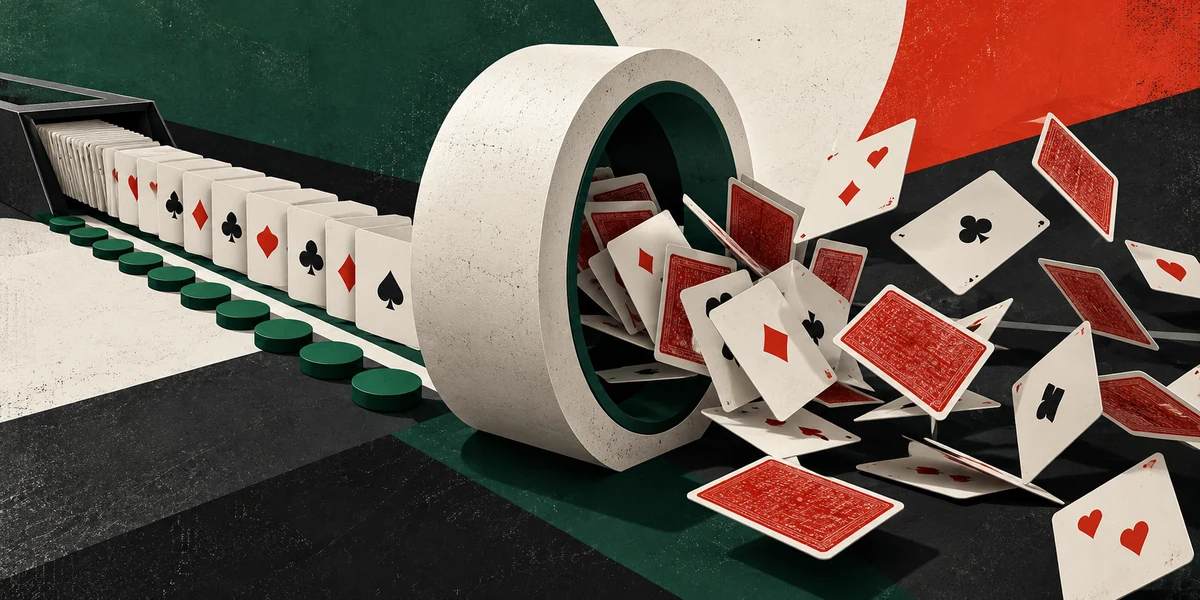
Every few weeks, an email lands in my inbox from a player convinced they have cracked the code. The pitch is always the same: "Marcus, I've got a running count spreadsheet open on my second monitor, I'm watching a live dealer stream, and nobody can see me. Why isn't everyone doing this?" It's a reasonable question. It also has a blunt answer. The online environment strips away the conditions that make card counting profitable. Some of that is the math of the shuffle. Some of it is casino operations. This guide walks through both, with numbers, so you can stop chasing a phantom edge and put your energy into things that actually pay.
The Fantasy: A Spreadsheet Next to the Stream
On paper, online live dealer blackjack looks like a counter's dream. Studios run by Evolution, Pragmatic Play, and Playtech deal from real physical shoes, which is how they are streamed on platforms like 1win and Stake. Nobody watches your eyes. No pit boss notices your lips moving. You can track every card at your own pace, convert to a True Count with a calculator, and size your bets with software help that would get you thrown out of any land-based casino in the world.
That's the fantasy. The flaw is that a perfect count of a badly dealt shoe is worth almost nothing. Counting doesn't make money just because you can see the cards. It makes money when the remaining cards become rich enough in tens and aces, often enough, that you can bet big into those moments. Online studios have engineered those moments almost out of existence.
If you need the mechanics of the count itself refreshed, the Hi-Lo system mathematical proof on BlackjackMath.org covers the card values, the running-to-true conversion, and the derivation of why a positive count shifts the edge toward the player. I won't repeat that derivation here. What matters for us is what happens when you apply that system to an online shoe.
Brick Wall #1: Shoe Penetration
Why Penetration Is Everything
Penetration is the share of the shoe dealt before the cut card comes out and the dealer reshuffles. It is the single most important variable in a counter's game. The True Count equals the running count divided by the decks remaining. Early in the shoe, the divisor is large, so the True Count stays close to zero. Only deep in the shoe, when few decks remain, does the True Count swing hard enough to reach the +3, +4, and +5 territory where the player's edge appears.
In brick-and-mortar casinos, serious advantage players won't sit at an 8-deck shoe unless it's dealt to roughly 75%–85% penetration, meaning 6 to 7 decks out of 8. Anything shallower and the profitable counts arrive too rarely to justify the variance and the heat.
In online live studios, the cut card is typically placed around 50% penetration. Roughly 4 of the 8 decks are dealt, and the remaining 4 never see the felt. That isn't an accident or a dealer's habit. It's studio procedure, and it's consistent across the major providers.
Key Concept
Card counting value isn't spread evenly through the shoe. Most of it sits in the last few decks dealt. Cutting at 50% doesn't cost a counter half the edge. It removes the portion of the shoe where nearly all of the edge lived.
How Often the Count Actually Goes Positive
Here's where the reality check hits. The table below shows approximate frequencies for a standard Hi-Lo count in an 8-deck game at different penetration levels. These are illustrative modeling figures, not an exact proof. The precise mathematics are on BlackjackMath.org's breakdown of deck penetration impact on True Count on BlackjackMath.org.
| Penetration (8-Deck Shoe) | Decks Dealt | Approx. Rounds at True Count +3 or Higher | Typical Environment | Counter's Verdict |
|---|---|---|---|---|
| 50% | 4.0 | Under 3.2% | Online live studios | Unplayable |
| 65% | 5.2 | ~6% | Conservative land casinos | Marginal at best |
| 75% | 6.0 | ~9% | Standard land-based shoe | Playable with discipline |
| 80% | 6.4 | Over 11.5% | Good land-based shoe | Solid opportunity |
| Continuous / per-hand shuffle | N/A | Effectively 0% | RNG tables, CSM games | Counting impossible |
At 80% penetration, more than one round in nine gives you a meaningful edge to bet into. At 50%, it's fewer than one in thirty. Those profitable rounds also tend to arrive in the last few hands before the cut card, so a single unlucky shoe can produce none at all.
Brick Wall #2: Reshuffling Frequency
RNG Tables: A Fresh Deck Every Hand
Standard RNG (software) blackjack tables are the easiest to dismiss. On most of them, the virtual shoe is reshuffled after every hand, which works like a perfect Continuous Shuffling Machine. Nothing carries over from one round to the next, so there's no running count to keep. Every hand is dealt from a full, randomized shoe, and the composition-dependent edge that counting exploits never builds up.
The same applies to most crypto-native "provably fair" games. Their cryptographic seed system lets you verify each outcome after the fact, but the cards are generated fresh each round. Our Provably Fair guide explains how to verify those results and why verification and countability are two different things. For a broader comparison of the two formats, see our RNG vs Live Dealer overview.
Live Studios: Shallow Cuts and Rapid Shoe Changes
Live studios use physical cards, but the operation is built around throughput, not around giving counters a deep shoe. Many tables rotate pre-shuffled shoes, so the reshuffle happens off-camera and play resumes almost immediately. Some products, like the "infinite" or common-draw formats where unlimited players share one hand, run on automatic shufflers that return cards to the pool continuously. Those tables are mathematically identical to a CSM for counting purposes.
Warning:
Be skeptical of any "online counting system," paid course, or bot that promises profits at live or RNG tables. If the product doesn't open by addressing 50% penetration and per-hand shuffles, the seller either doesn't understand the math or is betting that you won't. The only reliable winner in that transaction is the person selling the software.
The Bet Spread Dilemma
Suppose you accept the shallow shoe and play anyway. Counting has two halves: knowing when you have the edge, and betting much more when you do. Your flat bets in neutral and negative counts are paying the house edge, roughly 0.4%–0.6% under decent live rules. Your big bets in positive counts have to win that back and then some.
When favorable counts appear in fewer than 3% of rounds, the arithmetic gets brutal. To overcome the base edge you're paying on the other 97% of hands, you'd need something like a 1-to-30 or 1-to-50 bet spread: $10 minimum bets that suddenly jump to $300 or $500 when the count rises. Even then, the overall edge is thin and the variance is enormous. You'll ride long losing stretches that require a bankroll most recreational players don't have.
Surveillance Doesn't Need a Pit Boss
In a land-based casino, a 1-to-30 spread draws attention from human eyes. Online, it's caught by software. Every bet you place is logged with a timestamp, the shoe position, and the cards dealt. Operators and studio providers run automated risk tools that compare your bet-size changes against shoe composition. A player who bets the minimum for 40 hands and then raises fiftyfold right before the cut card produces the clearest pattern their software is built to find.
The usual responses are quiet and quick: reduced table limits, restrictions to flat betting, removal from bonus eligibility, or account closure. You don't get a backroom chat. You get an email, and sometimes a long verification process before you can withdraw your balance.
Warning:
Card counting isn't illegal, but online casino terms of service routinely give the operator broad discretion to limit or close accounts for "irregular play" or "advantage play." Using external software to assist decisions can also breach the terms outright. Read the terms before you risk your balance. The house writes the rules and enforces them.
The Hourly Wage Problem: Slow Deal Pace
The last brick wall is speed. A live dealer table averages roughly 45–55 hands per hour. Betting windows, card reveals, multiple seats, and studio pacing all slow the game. A heads-up land-based game can run twice that or more.
Advantage play is a job measured by hourly expectation: average bet × hands per hour × edge. Run the numbers below and the online picture is clear.
| Scenario | Hands / Hour | Average Bet | Player Edge | Hourly Expectation |
|---|---|---|---|---|
| Online live, optimistic counting edge | 50 | $40 | +0.20% | ~$4.00 |
| Online live, flat basic strategy | 50 | $40 | −0.50% | ~−$10.00 |
| Land-based shoe, 80% penetration | 90 | $60 | +1.00% | ~$54.00 |
Even if you squeezed a theoretical 0.20% edge out of a 50% shoe, which would require heavy spreading and luck in avoiding detection, you'd be grinding for roughly $4 an hour. That return would be swamped by variance and put your account at constant risk. You'd make more mowing lawns, and with far less stress.
Sharp Tip (Marcus Vance):
Treat counting online as a training exercise, not an income stream. Keeping a running count on a live stream is excellent practice for land-based play: true count conversions, staying accurate through distractions, and building speed. Just keep your bet flat while you practice. That way you build the skill without leaving a betting footprint that flags your account.
Where Online Sharps Actually Focus Their Energy
None of this means online blackjack is a waste of a sharp player's time. The levers are different. Here's where serious online players put their effort.
1. Flawless Basic Strategy Execution
The gap between a casual player and a perfect basic strategy player is often 1% or more of every dollar wagered. That matters more than any counting edge you could pull from a 50% shoe. Online, you have no excuse for mistakes: you can keep a chart open beside the stream legally and comfortably. Build one that matches your table's exact rules with our Strategy Chart Builder tool. Generic charts cost money when the rules differ.
2. Ruthless Table Selection
Online lobbies offer dozens of blackjack variants, and their rule sets differ a lot. Rule selection is the closest thing to a free edge improvement you'll find. The table below shows approximate effects on house edge relative to a standard 8-deck game.
| Rule | Approx. House Edge Impact | Action |
|---|---|---|
| Blackjack pays 6:5 instead of 3:2 | +1.35% to +1.40% (bad) | Never play |
| Dealer hits soft 17 (H17) vs. stands (S17) | +0.20% to +0.22% (bad) | Prefer S17 |
| Double After Split (DAS) allowed | −0.14% (good) | Seek out |
| Late Surrender offered | −0.07% to −0.08% (good) | Seek out and use correctly |
| Double on 9–11 only (vs. any two cards) | +0.09% to +0.10% (bad) | Avoid when alternatives exist |
Deck count matters too, though less than most players think in shoe games. Our Deck count at the table guide breaks down when fewer decks actually move the needle. Side bets are the other big trap. Nearly all of them carry house edges many times higher than the base game, so skip them.
3. Clearing Promotions With Positive Net EV
This is where real online advantage play happens. A deposit bonus is real money added to your expectation, as long as the wagering requirements, game weighting, and maximum-bet rules leave you with positive net EV after the house edge you pay while clearing it. The calculation is simple: bonus value minus (total wagering required × house edge of the game you clear it on). A $200 bonus that requires $4,000 in blackjack play at a 0.5% edge costs about $20 in expected losses, which leaves roughly $180 in positive expectation. Many casinos weight blackjack at 10% or 0% toward wagering, so read the terms carefully, and expect operators to restrict players who only take bonuses.
4. Maximizing VIP Volume Cashback
Rakeback, cashback, and VIP reload programs pay you a percentage of your volume or losses regardless of results. Combine perfect basic strategy at a low-edge table with a strong cashback program, and the net cost of play can drop close to zero. In some cases it can cross into slightly positive territory. Those gains are far more reliable than chasing true counts on a half-dealt shoe. Our Rakeback, Cashback and VIP guide shows how to compare programs and calculate your effective edge after rewards.
Sharp Tip (Marcus Vance):
Before every online session, run this quick check. First, confirm the table pays 3:2. Second, look for S17, DAS, and Late Surrender. Third, have a rules-matched strategy chart open. Fourth, check whether your play is clearing a positive-EV bonus or earning cashback. If you can't tick at least the first three, close the tab. Discipline in choosing where to play is worth more than any count.
A Word on Discipline and Risk
Even with every edge in your favor, online blackjack is a negative-expectation game for most players most of the time. Set a session bankroll before you sit down, use the deposit and loss limits your casino provides, and never chase losses by increasing your bets. Real advantage play starts with knowing when the math isn't on your side.
Bottom Line
You can count cards online, but you can't profit from it in any meaningful way. Live studios cut around 50% penetration, so True Counts of +3 or higher show up in fewer than about 3.2% of rounds, compared with more than 11.5% in a well-dealt 80% land-based shoe. RNG tables and continuous shufflers reset the count every hand. The 1-to-30-plus spread needed to profit is caught quickly by automated surveillance, and 45–55 hands per hour caps even a best-case edge at pocket change. Use online play to practice your count with flat bets. Put your real effort into perfect basic strategy, strict rule selection, positive-EV promotions, and cashback programs. That's where online sharps make their money.